
Have You Met My Kid?
Every one of these mailers rests on a premise nobody says out loud: that a child is a blank sheet, and whoever writes on it last wins. A registered Republican, and a co-founder of this site, on what a parent actually holds, what Florida law already guarantees you, and what the school board was really voting on while we were all being told to worry. Our fact-check rides at the bottom.
By Ali Olivo · July 27, 2026
I am a registered Republican, and I am not at all worried that my children will be indoctrinated by teachers.
I am scratching my head at the mailers and social posts in this nonpartisan school board race. This race is nonpartisan for a reason. Your politics should not have a bearing on whether you can do the job.
But the part that stops me is not the politics. It is the premise.
The premise nobody says out loud
Every one of these mailers rests on the same quiet assumption. That a child is a blank sheet. That whatever an adult writes on it last is what stays. That my daughter can sit in a classroom, hear something one time, and come home someone else.
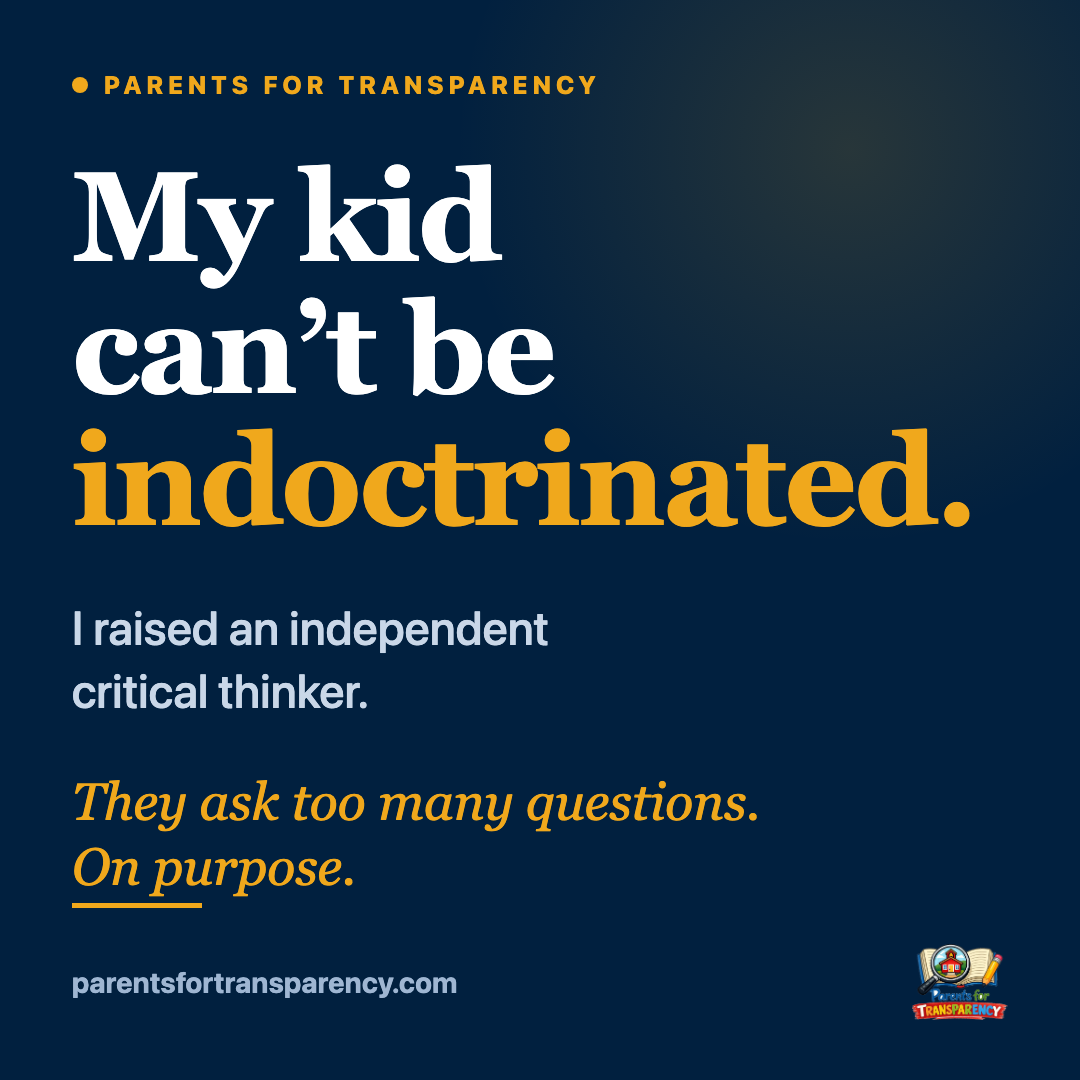
I raised my kids to ask questions, to check where things come from, and to think for themselves. So when a flyer tells me a teacher can flip my child's beliefs in a semester, my first honest reaction is not fear. It is: have you met my kid?
I do not believe that about my children. And I do not believe it about yours.
Count what a parent actually holds
Set the politics down for a minute and just look at what is on your side of the ledger.
- Time. Florida funds a school year at 720 instructional hours in kindergarten through third grade and 900 hours in fourth through twelfth. Spread across 180 days, that is four to five hours of actual instruction a day, in a class the state caps at 18 to 25 kids. You have every other hour, and all the years on either end.
- Authority. You are the person they come home to. You are the one whose opinion they are still arguing with at 30.
- The law, in writing. Florida's Parents' Bill of Rights says a parent has the right to direct the education and care of their own child, and to direct their upbringing and their moral or religious training.
- The receipts. Every instructional material and every library book has to be posted in a searchable list on the district's own website. Lee County has the page, the objection form, and a public list of every book ever challenged here and exactly what happened to it. You can read all of it tonight without asking anyone's permission.
- The exit. A scholarship, a charter, a private school, or your own kitchen table. Last year Florida handed out more than 524,000 school choice scholarships, and 4,270 kids right here in Lee County were homeschooled. The state will help pay for three of the four.
That is not a parent who needs rescuing. That is a parent holding every card in the deck.
So what is that flyer actually saying?
When someone tells me a school board seat is the last thing standing between my child and indoctrination, they are saying something about my child. And something about me.
They are saying my kid cannot hold her own in a room. They are saying that whatever I have built at home since the day she was born can be undone by a Tuesday.
I do not accept either one. And I would not accept it about your kids either.
A parent who believes their own influence is that thin is a parent who will hand a lot of things over to whoever promises to protect them. It is worth asking who that arrangement is good for.
Meanwhile, here is what they were actually voting on
While all of this was landing in our mailboxes, the school board held a meeting. July 21. The agenda ran about 83 items, and 76 of them were voted through as one block. Some of what was in it:
- Free dental screenings for students from a Ronald McDonald Care Mobile.
- $6.45 million in state mental health money.
- Athletic trainers at student sporting events.
- The Foster Grandparent Program.
- A $6.7 million cut in state funding, tucked inside a routine budget amendment.
- A $1.28 million cut to Title I.
- Up to $4 million in new furniture spending.
- About $10 million in purchases riding other governments' contracts.
- A brand new charter school, approved inside the block.
- A $71,880 human resources conference, voted on in July for a trip that already happened in June.
The single biggest item was $14.3 million for special education services from fifteen outside providers, which federal law requires the district to provide.
Not one item on that agenda was about what a teacher is allowed to say to a child.
That is not a fluke of one meeting. Florida law lists 29 categories of things a school board must do. One of them is about what gets taught, and I want to be fair about that, because it is a real duty. The board is responsible for the content of the materials it puts in front of our kids, and it runs the process a parent uses to object to a book. But that is one out of 29. The other 28 are buildings, buses, budgets, personnel, lunch, records and law.
The thing I keep coming back to
A budget can be checked. A capital transfer has a number, an account line and a filing date, and any one of us can pull it up. A claim about indoctrination has none of that. You cannot audit it. You cannot request it. No vote will ever settle it, because it is a claim about what might be happening inside somebody's head.
That makes it an argument that cannot lose. Which is exactly why I stopped finding it persuasive and started finding it convenient.
The fiscal discipline they espouse
My belief is that some of these candidates have not demonstrated, in their stewardship of our tax dollars, the fiscal discipline they espouse. The repeated use of capital transfers while not curbing spending on consultants is not what is best for our kids. At least not what I consider is best for our kids.
Having worked in corporate for 18 years, I can also tell you that if I did not balance my budget, I would lose my job. And I know the talk track is that the budget is balanced. That is a legal requirement. But the way they got there is in part by non-renewing 275 teachers.
So again, when I vote on August 18th in the school board race, I care about whether the candidate is committed to doing what is best for our kids.
Stop making teachers the scapegoat
In looking at these teacher wishlists, I do not think they are trying to indoctrinate our kids. It is obvious to me that despite all the ways we have failed to provide a living wage or job security, these teachers are trying to keep our kids' physical (food), emotional (fidgets) and intellectual (books) needs met. So why don't we stop making them the scapegoat and start asking ourselves what is best for our kids?
Do something about it today: See what Lee County teachers are actually asking for, and take one thing off a list
Fact check
Sourced and accurate, with one narrowing. The instructional-hour rules, the Parents' Bill of Rights, the exemption right, the transparency requirements, the school choice and home education numbers, the 29 statutory duties, the July 21 agenda, and the district's budget and staffing figures all check out against primary sources. The one qualification: Florida's 18 to 25 class-size caps are real but apply to core courses only, after the Legislature narrowed that definition in 2011, so they do not govern every class on a child's schedule. Her reading of what the mailers imply, and her judgment about candidate stewardship, are opinion and are labeled. She names no candidate and quotes no specific mailer, and she concedes the strongest counterargument herself, that oversight of instructional materials is a real board duty.
This op-ed is Ali Olivo's opinion. In the interest of disclosure, the author is a co-founder of Parents for Transparency, and her piece was checked to the same standard as every other submission we publish, including arguing the other side of each claim. A second disclosure belongs here: the statutory and budget research was compiled by us at her request, so we are checking material we helped assemble, and we have tried to be harder on it for that reason. The piece makes an argument about what political messaging implies. That part is her opinion and is labeled as such below. The facts underneath it are checkable, and they are checked here, including the one figure where the law is narrower than her sentence suggests.
Checked The nonpartisan ballot, Florida's instructional-hour and class-size rules, the transparency and parental-rights statutes, the school choice and home education numbers, the 29 statutory duties of a school board, the July 21 agenda, and the district's budget and staffing figures
This is a nonpartisan race, and she votes in it on August 18.
Correct. Florida school board elections are nonpartisan under the state constitution. Amendment 1 on the November 2024 ballot would have made them partisan starting in 2026; it drew about 55 percent yes, short of the 60 percent Florida requires, and failed. So every registered Lee County voter gets a school board race on the August 18, 2026 primary ballot regardless of party or of no party affiliation. One detail worth knowing: Lee elects seven members, five from single-member districts voted on only by residents of that district, plus two at-large. Four seats are on this ballot. Districts 1, 4 and 5 appear only for residents of those districts, and District 6 is at-large, which puts it on every Lee County ballot.
Florida funds 720 instructional hours in K-3 and 900 in grades 4-12, which is four to five hours a day across 180 days.
Accurate. Section 1011.61, Florida Statutes, defines a full-time student as not less than 900 net hours for grades 4 through 12 and not less than 720 net hours for kindergarten through grade 3. Divided across a 180-day year, that is four hours a day in K-3 and five in grades 4-12 of funded instructional time. The school day itself is longer, because it includes lunch, transitions, specials and dismissal. The author's point is about how the hours compare to the rest of a child's life, and on that the arithmetic holds either way.
A class the state caps at 18 to 25 kids.
The numbers are right, the coverage is narrower than the sentence implies, and readers should know it. Florida's class size amendment, approved by voters in 2002 and fully effective in 2010-11, caps classes at 18 students in prekindergarten through grade 3, 22 in grades 4 through 8, and 25 in grades 9 through 12. The caveat: those caps apply to core curricula courses, and in 2011 the Legislature narrowed the definition of core courses, which cut the number of classes subject to the caps by roughly two thirds. So the caps are real for core academic classes and do not govern every class on a child's schedule.
Florida's Parents' Bill of Rights, and the written right to exempt a child from certain instruction.
Quoted accurately. Section 1014.04 states that a parent has the right to direct the education and care of his or her minor child and the right to direct the upbringing and the moral or religious training, and it preserves the right to choose public, private, religious or home education. Related and worth knowing: section 1003.42 provides that any student whose parent makes a written request to the principal shall be exempted from the teaching of reproductive health or any disease, that a student so exempted may not be penalized for it, and that each district must post that right and the process on its website homepage, along with a link for parents to review the instructional materials used.
Every instructional material and library book must be posted in a searchable list, and Lee County runs the page, the form, and the list of challenged books.
Both halves confirmed. Under House Bill 1467, signed March 25, 2022, each district must publish, in a searchable format prescribed by the Department of Education, a list of all instructional materials, and each elementary school must publish a searchable list of everything in its library media center or on a school or grade-level reading list. Parents must be included on the committees that rank, eliminate or select materials, and districts must give public access to materials at least 20 days before the board takes official action. Locally, the district maintains an instructional materials page under Curriculum Standards on leeschools.net, an objection process, a Challenge to Instructional and Media form, and a published list of the library books formally challenged here with the outcome of each challenge.
More than 524,000 scholarships statewide, and 4,270 homeschooled students in Lee County.
Both verified. For 2024-25 the state reports more than 524,000 scholarships awarded across the Florida Tax Credit, Family Empowerment Scholarship for Educational Options and Family Empowerment Scholarship for Students with Unique Abilities programs. The Florida Department of Education's Home Education in Florida 2024-25 Annual Report puts statewide home education at 152,871 students from 114,370 families, and lists Lee County at 4,270 students from 3,116 families. For accuracy: statewide home education is up 6.6 percent over five years, not the steeper climb sometimes quoted, and it edged down slightly from the prior year.
Section 1001.42 lists 29 categories of school board duties, and one is about what gets taught.
Correct, and the piece concedes the strongest counterargument itself. Section 1001.42 enumerates 29 numbered subsections, and subsection (9) is Courses of Study and Other Instructional Materials. That duty is real and substantial: section 1006.28 makes each district school board responsible for the content of all instructional materials used in its schools, requires the searchable list, and requires the parent objection process, with anything found pornographic removed within five school days. One caveat readers deserve: section 1001.42 is not the entire universe of a board member's obligations, since other statutes also bear on instruction. Counting its categories fairly shows the shape of the job. It is not a complete inventory of the law.
The July 21, 2026 agenda: about 83 items, 76 on consent, and the specific items listed.
This is our own reading of the district's published BoardDocs packet, which anyone can pull up. About 83 items appeared, 76 of them on the consent agenda voted as one block. Everything she lists is on it: the Ronald McDonald Care Mobile dental screenings (I-3), the $6.45 million state Mental Health Assistance Allocation (I-4), the Lee Health athletic trainer partnership (J-2), the Foster Grandparent Program (K-1), a budget amendment carrying a $6,696,856 FEFP reduction (L-17), a $1.28 million Title I reduction (L-6), up to $4 million in furniture authority (L-4), eleven piggyback purchases totaling up to about $10.05 million, a charter school approved inside the consent block (J-9), and the $71,880 human resources conference approved in July for a June event (L-9). The largest single item was $14.3 million in contracted special education services from fifteen outside providers (I-6), which federal law requires. On her closing observation, we reviewed the agenda and found no item governing the content of teacher speech.
275 teachers lost their jobs to close a budget gap, and a balanced budget is legally required.
Both correct. To close a projected $92.4 million operating gap for 2026-27, the district eliminated 457 positions, 275 of them teaching positions, through non-renewals of annual contracts rather than dismissals for cause. Non-renewal is a lawful budget action taken at the end of a contract year, and it is the district's own word for it. The district reports 682 teachers lost over the year, the 275 non-renewals plus 407 who left through ordinary attrition, and describes that combined figure as its smallest in five years. On the legal requirement: section 1011.02 provides that proposed expenditures, plus transfers and balances, shall not exceed estimated income, transfers and balances, and that the budget and each of its parts shall balance. A balanced adoption is the legal floor, not an achievement.
The repeated use of capital transfers.
Documented in the district's own filings, in consecutive years. In the 2025-26 district summary budget filed with the state on form ESE-139, Lee's general fund shows $45,243,118 in account 3630, transfers in from capital projects funds, about 3.6 percent of general fund appropriations. For 2026-27 the district's April 2026 budget overview shows another $45.4 million moving from capital to operations to help close the gap. Two things belong beside that in fairness: these transfers are legal and ordinary, and on the district's own twelve-district peer set Lee ranks eighth, meaning seven peers move a larger share of capital money into operations than Lee does. Whether the practice is imprudent is the author's judgment.
Not curbing spending on consultants.
Confirmed through the public record. The clearest documented instance: on March 4, 2025, the board voted a one-year, $180,000 contract with the lobbying firm Ballard Partners to seek more federal funding for the district. The firm registered as a congressional lobbyist the next day and received a first quarterly payment of $20,000. Two speakers objected at that meeting, a district carpenter who said the district needed to forget about lobbyists because people were leaving, and India Palencia, now a candidate, who said the money should go to teacher pay instead. That contract sits in the same window in which the district was projecting the shortfall it later closed by non-renewing 275 teaching positions. Contracted outside services were not cut on the scale that classroom staffing was, which is the comparison the author is drawing.
The teacher wishlists show food, sensory tools and books.
Accurate, and it is our own data. As of the July 22, 2026 canvass, 171 Lee County classroom lists were posted on our Teacher Wishlists page, 158 of them measured, totaling about $103,702 in items still needed against $3,382 already purchased by the public. The lists read the way she describes them: groceries and snacks, sensory items including fidgets, and classroom books are among the most common categories, alongside paper, pencils and cleaning supplies. For scale, Florida's classroom supply stipend was $300 per teacher in 2024-25, while the average list on our page has run roughly twice that.
What the mailers are really saying, who the arrangement is good for, and that some candidates have not shown the fiscal discipline they espouse.
These are the author's judgments and we are labeling them as such. She is reading an implication out of political messaging, not reporting a statement anyone made, and this fact-check takes no position on why any candidate or committee says what it says. She quotes no specific mailer and names no candidate anywhere in the piece, so there is no particular claim to run against the record. One structural note for readers weighing the stewardship point: only candidates who currently sit on the board have voted on these budgets, so that criticism can only attach to incumbents. Every candidate's own fundraising is on our School Board Race page.
The author's statements about herself: registered Republican, eighteen years in corporate, and how she raised her children.
Personal statements about her own party registration, career and parenting, offered as her account rather than as findings, and not independently verified here. Her conclusion that her children cannot be indoctrinated is a parent's belief, not a measurable claim.
Fact-check sources
- Fla. Stat. 1014.04 - Parents' Bill of Rights
- Fla. Stat. 1003.42 - Required instruction, including the written exemption right
- Fla. Stat. 1011.61 - Definitions, including net instructional hours
- Florida DOE - Class Size Reduction requirements and FAQ
- Ballotpedia - Florida Amendment 9 (2002), class size limits
- Florida House Bill 1467 (2022) - curriculum and library transparency
- School District of Lee County - Instructional Materials (objection form and challenged-materials list)
- Florida DOE - Home Education in Florida, 2024-25 Annual Report (statewide and Lee County figures)
- Florida DOE - K-12 school choice scholarship programs
- Ballotpedia - Florida Amendment 1 (2024), Partisan School Board Elections (rejected)
- Fla. Stat. 1001.42 - Powers and duties of district school board (the 29 categories)
- Fla. Stat. 1006.28 - Board responsibility for instructional materials and the objection process
- Fla. Stat. 1011.02 - Preparation and adoption of budget (the balance requirement)
- Full agenda packet, Lee County School Board, July 21, 2026 (BoardDocs)
- School District of Lee County - Budget Realignment and Non-Renewal Process
- WGCU - Millions spent on D.C. lobbying for Florida school boards (the $180,000 Ballard Partners contract)
- Florida DOE - Lee County district summary budget, 2025-26 (form ESE-139)
- Our Board Meeting Watch - our full read of the July 21 agenda
- Our Teacher Wishlists page - every list, updated as they are canvassed
- Our District Budget Watch - the capital transfer and how Lee compares
About the author
Ali Olivo Ali is a Fort Myers mom with two kids, 12 and 9. She has served on the Golden Apple Selection Committee for the Foundation for Lee County Public Schools and on the United Way Allocations Committee. She has more than 18 years of experience in corporate business, M&A, and law. She holds a B.A. from the University of Florida and a J.D. from Marquette University Law School.