
The $30 Million Question Behind Lee's Teacher Cuts
The board named a $47 million deficit and pointed to enrollment and lost federal money. All of that is real. But on the district's own list of comparison districts, Lee ranks fourth on teacher pay and eighth on how much of its capital it sends to the classroom. Closing that gap would have covered most of the shortfall, without a single teacher losing a job. Our fact-check rides at the bottom.
By Amber Cebull · July 24, 2026
In May, the district sent non-renewal notices to 457 employees, 275 of them classroom teachers. The Board Chair wrote to families that Lee was working to address a $47 million deficit, and he was straight about the reasons. Enrollment slipped. The federal covid money ran out. The district is moving to zero-based budgeting to steady itself. Every word of that is true, and I want to give it credit before I complicate it. Under Florida law a district has to adopt a balanced budget, and Lee did. It balanced it on 275 teachers.
So I did the thing I always do. I opened the actual budget, all 58 pages of the document Lee files with the state, and read it line by line. It holds something the message to families left out.
Related: What Would It Actually Take to Break the Chain: the network funding the board that made this call
Two funds, one wall, and a set of doors
A district does not run one budget. It runs two big ones. The general fund is the operating account, the one that pays teachers, and it is the account that came up $47 million short. The capital fund is separate, and it is not short. It pulls in around $427 million a year from property taxes, a voter sales surtax, and impact fees on all the new construction out here, and it began this year holding $754 million.
Here is the fair part first, and it is the first thing the district will say. Capital money cannot legally pay a teacher. Florida walls it off for buildings, buses, land, and equipment. Nobody can take that $754 million and turn it into salaries.
But the wall has doors. Florida law lets the capital fund cover a specific list of things the operating budget is carrying right now. Maintenance of the buildings. Property insurance on them. School buses. Computer hardware and software. Every dollar of that paid from the flush capital fund instead of the strained operating fund frees up operating money, and operating money is the only kind that can pay a teacher.
Lee already does this. It moves about $45 million a year from capital into operations. So this is not a district ignoring the tool. They use it. The question is whether they use it as hard as they could, and the answer is in the numbers.
Fourth on the chart they showed you. Eighth on the one they didn't.
I did not pick these districts. The district did. When the School District of Lee County wanted to show its teacher pay was competitive, it published a chart comparing Lee to eleven other Florida systems, the big urban districts plus our neighbors, and Lee came out fourth of twelve. So I took that exact same list of twelve and measured one thing: how much of each district's capital fund it moves into day-to-day operations, as a share of its operating budget. On teacher pay Lee is fourth. On this, Lee is eighth.
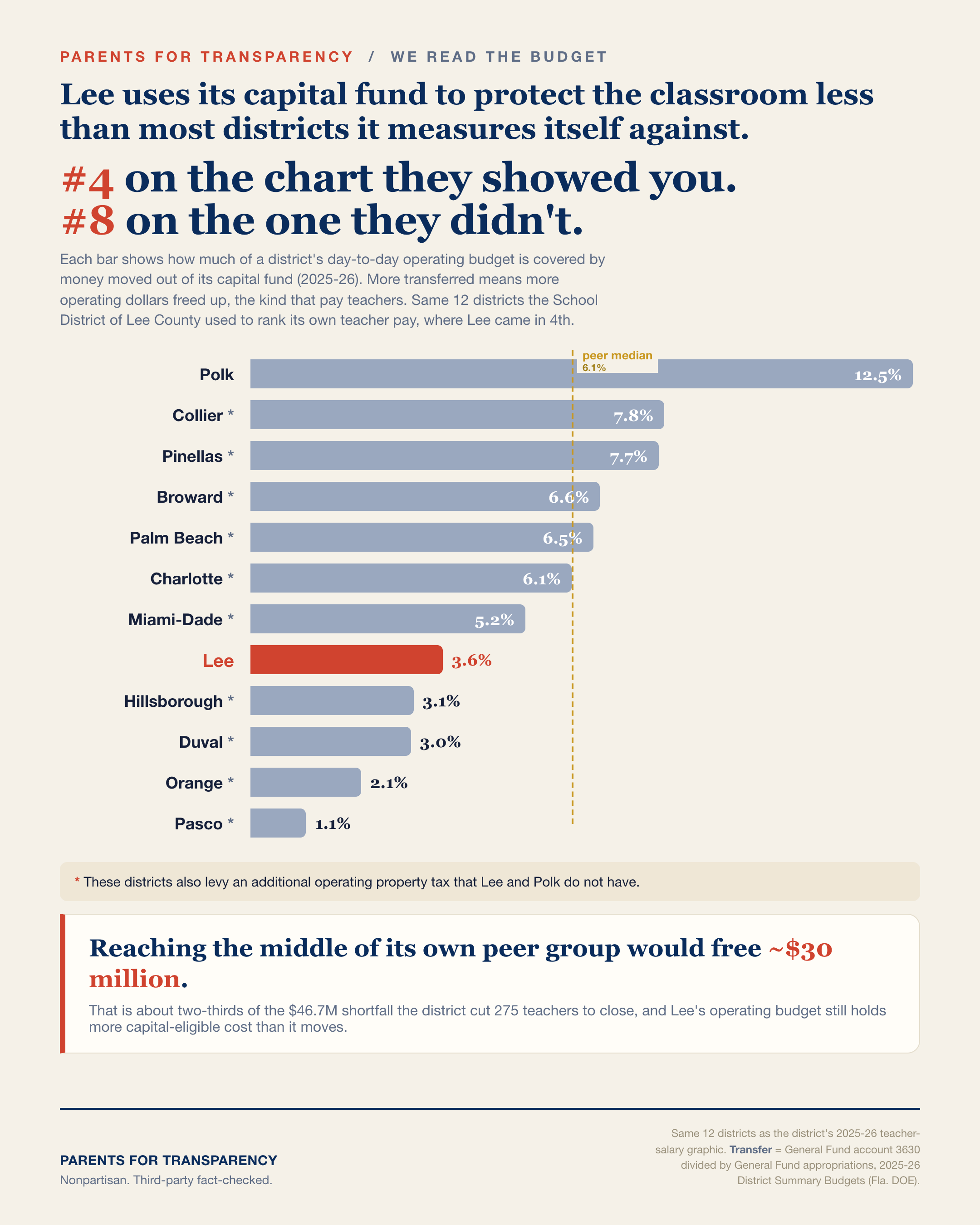
Lee moves 3.6 percent of its operating budget over from capital. The middle of the group is about 6 percent. Collier, right next door, is at 7.8. Pinellas is at 7.7, Broward at 6.6, Polk at 12.5. Four districts do move less than Lee, so Lee is not dead last. But it sits below the median of the district's own comparison group, on the very list the district uses to tell you its pay is competitive.
Now the gap the message to families did not mention. The distance between what Lee moves and what the middle-of-the-pack district moves is about $30 million. That is roughly two-thirds of the deficit they cut 275 teachers to close. Maybe Lee has less eligible cost than the districts above it and genuinely cannot close that gap. Maybe it can. Only the district knows, because only the district can see what its transfer already covers and what is left. And it cut the teachers without showing us either one.
And before anyone says that cushion is about to vanish with the property tax cuts, it is not. The property tax reduction heading to voters in 2026 protects public education. The Legislature exempted school district levies from it, so homeowners keep paying the school portion of their bill and the money that feeds this capital fund keeps coming. The tool is not going away. I believe Lee is just not using it.
The fair limits, and the bigger question underneath
Start with how broad the tool is. Florida law does not limit the capital fund to bricks and mortar. It can legally cover maintenance and the salaries of the people who do it, equipment and computer hardware and software, school buses and even contracted bus service, the rent on leased buildings, and the cost of meeting environmental rules. None of that can be a teacher's salary. But every dollar of it paid from capital instead of the operating fund leaves operating money free, and that money can be a teacher. The reason to move an eligible cost is not the deficit. It is that the law allows it. Closing the deficit is only what the freed money could have done.
So the fair question is whether that eligible cost is even there to move, or whether the only thing left in the operating budget really is teacher salaries. It is not. Read the operating budget by category and two lines jump out. Lee spends $52 million of operating money on capital outlay, the equipment and hardware and furniture that is capital-eligible by its own definition. It spends another $23 million on plant maintenance. That is $75 million of capital-eligible spending sitting in the operating fund. Even if you assume the entire $45 million transfer is already spoken for, at least $30 million of eligible cost is still parked in operations, before you count technology, buses, or the facilities salaries the law also allows. The claim that there was nothing left to move but teachers does not survive the budget.
I cannot tell you the transfer would land exactly at the peer median, because the budget reports it as a single unbroken line and will not show where the overlap is. But I do not need the exact figure to see the shape of it. There is far more eligible cost in the operating budget than Lee moves, Lee moves a smaller share of it than nearly every district around it, and 275 teachers were cut anyway.
And the capital fund is not even the end of it. Lee spends more than $200 million a year on outside contracts, purchased services the budget lists in a single line and never breaks down in public. I am not going to tell you where the waste is in that number, because I have not been able to see inside it. But I would bet this county that somewhere in $200 million of contracts there is money to be found before a teacher has to lose a job.
So here is the question
The board's explanation is accurate. It is just not complete. A $47 million deficit is real, and so is a capital fund that every comparable district uses harder than we do, and so is $200 million of contracts nobody has walked through. All of it is true at once, and only the first part made it into the message to families.
So before the next round of notices, I want the district to answer one thing in public, on one page. Why does Lee sit at the bottom of its peer group on this, and what would it take to reach at least the middle before a single teacher is cut? If the honest answer is that our eligible costs really are lower than everyone else's, show the worksheet and I will say so in plain language. And if the answer is that we have simply not pulled the lever as hard as Collier and Pinellas and Broward, then the classroom was cut before the homework was done.
Show us the work. Not the message. The work. A district that balances its budget on 275 teachers, while using the classroom's best financial protection less than anyone around it, owes this county more than a reason. It owes us the number it left out.
Fact check
Accurate on the numbers.
Every figure below was checked against the districts' own budgets filed with the state, Florida statute, and news reporting. The ratings cover the factual claims only. The conclusion is the author's opinion.
Checked Lee's teacher cuts and the capital fund
Lee gave non-renewal notices to 457 employees, 275 of them teachers, in May 2026 for the 2026-27 year, tied to a roughly $47 million shortfall.
Reported by WINK News and the Fort Myers News-Press, May 2026.
The Board Chair publicly described a $47 million deficit and pointed to enrollment decline, expiring federal covid funds, and zero-based budgeting.
The Board Chair's message to families, May 2026, on leeschools.net. He acknowledged the deficit; he did not deny it.
Florida law requires each district to adopt a balanced budget.
Chapter 1011, Fla. Stat. A balanced budget is a legal requirement, not proof that no less painful path to balance existed.
Lee's capital fund takes in about $427 million a year and began 2025-26 holding about $754 million.
Lee County 2025-26 District Summary Budget, Florida DOE form ESE-139, Section XIII.
Capital dollars cannot pay a teacher's salary, but can legally cover maintenance, equipment and technology, buses and contracted transportation, facility leases, environmental compliance, and the salaries of employees who support those activities.
Section 1011.71(2), Fla. Stat. Paying those costs from capital frees general-fund money that can pay teachers.
The School District of Lee County published a graphic ranking Lee fourth of twelve on average teacher salary for 2025-26, and this op-ed uses that same set of twelve districts.
The district's 'Average Teacher Salary 2025-2026, Big 10 Florida Districts and Neighboring Districts' graphic, showing Lee at $62,687, rank 4 of 12.
Lee moves about $45.2 million from capital into its operating budget, equal to 3.6 percent of that budget. Among those twelve districts, that ranks eighth, below the peer median of 6.1 percent.
General Fund account 3630 divided by General Fund appropriations, from the 2025-26 District Summary Budgets for Lee and the eleven districts on its teacher-salary graphic: Collier, Charlotte, Pinellas, Palm Beach, Orange, Hillsborough, Broward, Miami-Dade, Duval, Polk, and Pasco. Four of the eleven transfer a smaller share than Lee.
The gap between Lee's transfer and the peer-median rate is about $30 million, roughly two-thirds of the $46.7 million shortfall.
6.1 percent of Lee's general-fund appropriations is about $75.6 million, versus $45.2 million now. Whether Lee could shift enough eligible cost to close it is not spelled out in the public budget.
Lee's operating budget includes about $52 million of capital outlay and $23 million of plant maintenance, both capital-eligible, while it shifts about $45 million to capital. It also spends more than $200 million a year on purchased services.
Lee County 2025-26 District Summary Budget, Section II: general-fund capital outlay (object 600) $52.3M, Maintenance of Plant (function 8100) $23.3M, Purchased Services (object 300) $203.8M.
The 2026 property-tax reduction protects public education. The Legislature exempted school district levies, so it does not cut the revenue feeding this capital fund.
HJR 1F as amended: the new homestead exemptions do not apply to school levies, so homeowners keep paying the school portion of their tax bill. Florida Phoenix and CBS Miami, June 2026.
Fact-check sources
- Lee County 2025-26 District Summary Budget (Florida DOE, ESE-139)
- Florida DOE School District Summary Budgets (all districts)
- WINK News: Lee County schools cut 275 teachers amid $46M budget deficit
- Florida Phoenix: Legislature changes the math to protect schools from the property tax plan
- Section 1011.71, Fla. Stat. (district capital outlay millage uses)
About the author
Amber Cebull Amber is a Fort Myers native. Her two kids, 13 and 12, go to Cypress Lake Middle School. She grew up in Lee County schools herself: Tanglewood Elementary, Allen Park Elementary, Paul Laurence Dunbar Middle School's Gifted Program, Fort Myers High School's IB Program. She graduated from the University of Central Florida with a B.A. in English Literature and a minor in Psychology. An entrepreneur for 15 years, she has owned multiple businesses in the Fort Myers area, including a marketing and business strategy consulting practice and a brewery in Downtown Fort Myers.