
The Poll Was Voluntary. So Why Was Partisanship Required?
A poll went out by text in School Board District 5. Its last question makes you name a political party before it will let you finish, in a race where no party appears on the ballot. Florida voters have now rejected that idea twice. Here is how a question like that works on you, and how to see the next one coming. Our fact-check rides at the bottom.
By Amber Cebull · July 30, 2026
At 7:40 Thursday evening a text landed on a Lee County voter's phone, from an 813 number, which is the Tampa area rather than this one. It carried stock art of smiling people over the words LEE COUNTY VOTER SURVEY. The message under it opened with the words Outbound Message, which is what an unremoved merge field looks like when a bulk send goes out in a hurry. Then this.
Hello, it's Catalyst Research! We are conducting a poll on important issues in the Lee County School Board, District 5. Your response is voluntary and will be kept strictly confidential. [survey link] Reply Stop to End
Text received by a District 5 voter, July 30, 2026, 7:40 p.m.
Hold onto the word voluntary. The link went to a seven-question survey that takes about two minutes. At the end of those two minutes, this.
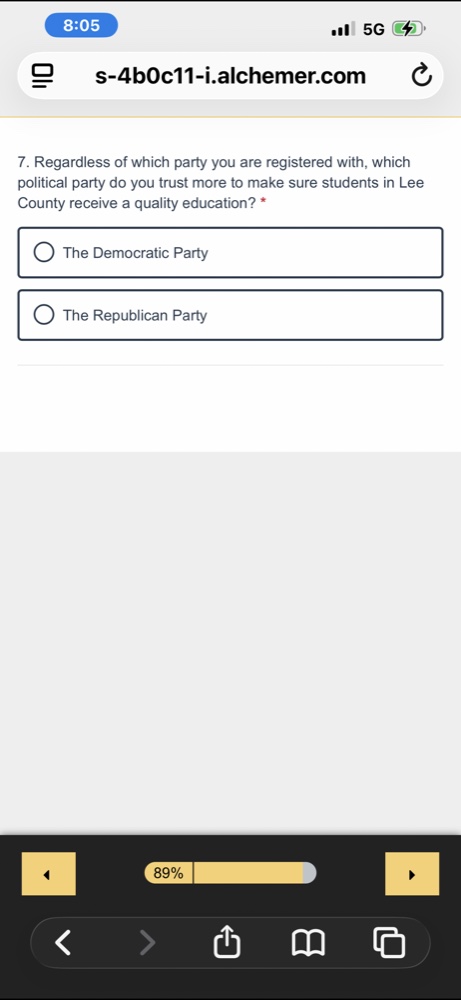
Voluntary was their word, not mine
That red asterisk means required. The platform will not let you move forward until it is answered. The message promised a voluntary poll. The instrument made the party question mandatory, and the promise and the build come apart at exactly one place: the only question with nothing to do with running a school district.
Notice too that nothing on that screen is false. No lie to correct, no candidate named. Hand it to a fact-checker and they hand it back, because it does not assert anything. It asks. The persuasion is not in the content. It is in the architecture.
Two words, one answer
The wireless carriers publish a rulebook for automated messaging, and every legitimate texting vendor in America builds to it. Reply STOP and the sender must stop. Reply HELP and the sender is supposed to write back and say who they are. STOP is the exit. HELP is the front door.
At 9:03 that night the voter typed HELP. Seconds later, STOP.
STOP got an answer almost immediately. You have successfully unsubscribed. HELP got nothing. Not then, and not since.
That sequence says more than silence would. The system on the other end is not asleep. It read a message, matched a keyword, and wrote back in seconds. It answers the word that makes a person go away. It did not answer the word that would have told her who she was talking to.
Honest caveat, and credit where it is due: the two words went seconds apart, so an opt-out may have swallowed a queued reply. The Stop instruction is there and it works, and the sender does put a name on itself. What is missing is the one thing HELP exists to hand you, which is a way to reach a person and ask who is paying. If this text hit your phone, send HELP by itself and tell us what comes back.
Florida already answered this question
In November 2024 voters were handed this exact idea in plain language. Amendment 1 would have put party labels on school board ballots starting in 2026. It took 55 percent, needed 60, and failed. In 1998 voters had removed those labels in the first place.
Twice this state has been asked whether it wants school boards chosen by party. Twice it said no. So when your phone buzzes in July of 2026 asking which party you trust with your child's education, you are being asked a question the ballot box already declined to put in front of you.
Why a question like that works
To answer it at all, you have to accept that party is the right lens for judging who runs a school district. That premise is never argued. It arrives underneath the question, where you are not looking, because your attention is busy choosing between two boxes.
And there are only two. No neither. No both about the same. For a great many parents here, neither is not a dodge, it is the sincere answer, and probably the most common one. Leaving it off does not fail to record that view. It denies the view exists.
Then the real move: the survey never tells anyone to vote by party. It gets the voter to say it. A position you produce yourself is far harder to shake than one handed to you, because you never got the chance to resist it, and people act consistently with what they have committed to. That is the bridge from a survey answer to a vote. Nobody was talked into anything. They watched themselves decide, which feels exactly like thinking.
The placement finishes it. At 89 percent, this is the last question, after six that canvassed parties, outside groups and candidates. What you are asked first changes what your next answer means, and this is the last thing a person reads before setting the phone down.
The sentence somebody worked on
Regardless of which party you are registered with.
That clause is the most deliberate thing on the screen. It reads as open-mindedness and functions as permission, telling a registered Republican or Democrat that crossing over is welcome here. In sales you would call it handling the objection before the prospect raises it. Which tells you the writer knew there was an objection. Somebody anticipated the thought wait, this race has no parties on the ballot, and defused it before the reader could finish forming it.
This is what propaganda actually is, and it is not lying. Its first job is convincing you a two-sided conflict exists. After that it runs itself, because someone who believes there are two sides already knows which one they are on. Give people two boxes and no third and you have not measured a division in Lee County. You have manufactured one. This board oversees a hundred thousand children, a budget in the billions, buildings that need roofs, and the heaviest counselor caseload of any large district in Florida. There is no Democratic position on a roof.
Somebody paid for this
Text messages are not free. Every message sent through a carrier-registered service is metered, and this survey runs on Alchemer, a commercial platform built for market researchers rather than the free form builder anyone can open in a browser.
Nobody has told us how many phones it reached, so here is the arithmetic with the assumptions showing. Lee County had 491,877 registered voters as of June 30. Five single-member school board districts puts District 5 somewhere near 90,000 to 100,000 of them. Political picture messages generally run three to ten cents apiece depending on volume and vendor. Reach the whole district and you are in the neighborhood of three to ten thousand dollars in messaging alone, before the platform, the list, or anyone's time. Reach a slice and it scales down.
Treat that as a range, not a receipt. The real number is whatever a filed campaign finance report eventually says, and that is the only number we would print as fact.
What I am not going to tell you
The message says who sent it. It does not say who paid, and those are different questions. It identifies itself as Catalyst Research. I went looking and could not confirm a polling firm operating publicly under that name, which is not an accusation, just a statement about what I could verify. The survey does not close the gap either. I opened it. The landing page names no client, no committee, and no way to reach anyone.
None of that breaks a rule. A survey is generally not a political advertisement under Florida law, so it carries no paid for by line. That is not a scandal. It is why the method is attractive to whoever chose it.
And the other side, fairly: message testing is normal. Every serious campaign asks voters what moves them, and wanting to know whether a trust frame lands is not wrong. If this went to a few hundred people in a controlled sample, it is research with a badly built instrument, and the honest word is sloppy rather than sinister. What none of us knows is how many phones it reached, and that number is the whole difference. If you want to know who paid, the answer sits in the expenditure filings, where payments to vendors are itemized by name.
The test that works on anything
You do not need any of the research above to protect yourself from this. There is one test and it fits in a sentence. Honest persuasion survives being described out loud. Manipulation does not.
I can tell you exactly what I am doing to you right now. I am arguing that this question was engineered to make a nonpartisan race feel partisan. Knowing that does not weaken my case, because it works by handing you reasons and letting you check them. Now try it on the survey. Imagine the text had opened by explaining that its last question is built to leave you thinking about the school board in terms of party. It stops working in that instant. Every reader sees the wires.
A technique that only functions while you cannot see it is not an appeal to your judgment. It is a route around it.
What you are owed
You are owed a question you can answer honestly. If neither is what you actually think, neither belongs on the screen. You are owed the name of whoever is asking, not because the law requires it here, but because people who believe their case is strong do not usually mind signing it.
The next one will look different. They always do. The structure will be the same, so check it the same way. Count the options. Notice what happens to you if you answer. Find the sentence someone wrote to tell you not to worry about it.
You are allowed to close the survey.
Fact check
Accurate on every checkable claim. The quoted text message and the description of question 7 both match the screenshots, and the survey's landing page was read directly rather than taken on report. The Amendment 1 and 1998 history is correct. The sharpest new finding, that a message promising a voluntary response led to a question the software would not let a respondent skip, is visible in the two images side by side and is not disputed here. The claims about what the question does to a reader are interpretation drawn from established findings in survey methodology and social psychology, and the piece labels them as its own analysis. Its most important restraint is that it reports the name the sender gave and stops there, and that restraint holds throughout.
This op-ed is Amber Cebull's opinion and she is a co-founder of this site. It analyzes one survey question and the technique behind it. It names no candidate, accuses no campaign of sending the survey, and alleges no violation of law. The message identifies its sender as Catalyst Research, and the piece reports that name because the sender published it, but nothing here should be read as a finding about who that is or who hired them. Two limits are stated in the piece itself and are worth repeating here: we do not know who paid for the survey, and we do not know how many people received it. The second one matters, because a small controlled sample would make this ordinary message testing rather than a mass persuasion effort, and the piece says so in its own text rather than leaving the concession to this fact-check. Readers should also know that this site has a standing interest in how money and messaging move through these races, which is a reason to check the sources below rather than take our reading of them on trust.
Checked Two screenshots supplied by the District 5 voter who received the text and took the survey, the first showing the message as it arrived and the second showing question 7; the survey's own landing page, which we opened directly on July 30, 2026 without submitting a response; the recipient's account of replying HELP to the sending number and receiving nothing back; the CTIA Messaging Principles and Best Practices, sections 5.1.2, 5.1.3 and 5.2.1; the Florida Division of Elections and statewide reporting on the November 2024 vote on Amendment 1; the Florida House staff analysis of HJR 31, the joint resolution that placed Amendment 1 on the ballot; Alchemer's published product and pricing pages; Florida Statutes chapter 106 on political advertisements and disclaimers; and federal Common Core of Data counselor staffing figures for Florida districts retrieved through the Urban Institute Education Data Portal.
The text arrived July 30, 2026 at 7:40 p.m. from an 813 number, carried a LEE COUNTY VOTER SURVEY graphic, began with the words Outbound Message, and identified the sender as Catalyst Research.
All of it is legible in the screenshot of the message. The quoted paragraph is reproduced word for word. The op-ed reads the leading Outbound Message as an unremoved mail-merge field, which is an inference from its form rather than something the sender stated. On the phone number: 813 covers the Tampa area and Lee County is 239, but a vendor can hold a number from anywhere and text from anywhere, so this establishes nothing about who is behind it and the op-ed does not treat it as though it does.
The message promised that responding was voluntary, and question 7 was marked required.
Both halves are visible in the two screenshots. The message reads 'Your response is voluntary and will be kept strictly confidential.' Question 7 carries the red asterisk that Alchemer and every comparable platform use to mark a required field, which blocks submission until it is answered. The op-ed states that it does not know whether the same person wrote the message and built the survey, and it does not allege that the contradiction was deliberate.
The recipient texted HELP and then STOP at 9:03 p.m. STOP was answered with 'You have successfully unsubscribed.' HELP was not answered.
Both replies and the single response are visible in a screenshot of the message thread, timestamped 9:03 p.m. on July 30, 2026. The op-ed's inference, that a system which answers one keyword within seconds is capable of answering the other, is reasoning from that screenshot rather than a statement about the sender's configuration, which we cannot see. The op-ed states the competing explanation in its own body text: HELP and STOP were sent seconds apart, and an opt-out can suppress a reply already queued. It asks other recipients to send HELP alone rather than treating one thread as conclusive. Nothing here alleges a violation of law.
CTIA's rulebook requires a sender to answer STOP by stopping and to answer HELP with information about the sender.
Quoted from the CTIA Messaging Principles and Best Practices. Section 5.1.2: upon receipt of a STOP message the sender 'shall immediately cease sending messages to that consumer.' Section 5.1.3: upon receipt of HELP the sender 'shall... send back an in-band message comprising a brief description of the HELP capabilities of the message sender.' These are carrier-enforced industry standards, not statutes, and the op-ed says so plainly. In fairness to the sender, which the op-ed states in its own text: the message did carry a 'Reply Stop to End' instruction, that instruction worked, and the sender did put a name on itself, so section 5.2.1's identification expectation is arguably met.
Reaching every registered voter in District 5 by picture message would run roughly three to ten thousand dollars in messaging alone.
This is an estimate and the op-ed presents it as one, with the assumptions stated in its own body text rather than buried down here. The inputs: Lee County reported 491,877 registered voters as of June 30, 2026, and the school board has five single-member districts, so the piece assumes District 5 holds roughly a fifth of them. That is an approximation, because districts are drawn by population rather than by registration and the two do not divide evenly. Per-message pricing for political picture messaging varies by vendor, volume and carrier surcharge, and the three to ten cent band is a general market range rather than a quote anyone gave us. None of this is evidence about what this particular survey cost, how many phones it reached, or who paid for it. The op-ed says to treat it as a range and not a receipt, and that the only figure we would ever print as fact is one that appears in a filed report.
The survey takes roughly two minutes to complete.
Reported by the voter who took it, and consistent with a seven-question instrument of this kind. Twenty-five minutes elapsed between the arrival of the text and the timestamp on the question 7 screenshot, but that gap includes however long the phone sat before the link was opened, so it is not a measure of the survey's length and the op-ed does not present it as one.
The survey link carries a tracking parameter unique to the recipient, so answers are confidential from the public but not anonymous to whoever is running it.
The link in the message ends in an sguid parameter, which in this platform ties a response session to the specific contact a link was sent to. This is standard practice in survey and email software and is not improper in itself. We have not seen the sender's account and cannot say what they do with it. The narrow and checkable point is that a per-recipient identifier is present, which means 'strictly confidential' should not be read by anyone as 'the sender cannot tell it was you.'
The survey's own landing page names no sponsor, client, or committee.
We opened the survey URL on July 30, 2026 and read the introduction page without submitting anything. It states that someone is conducting a local Lee County poll on the upcoming School Board election and issues that matter to local voters. There is no organization named, no contact information, and no privacy or sponsorship disclosure on that page. We did not advance through the survey, because clicking through would have injected a response into someone else's data.
We could not confirm a polling firm publicly operating under the name Catalyst Research.
We searched for the name and found no firm we could confirm as the sender. This is an absence of evidence and nothing more. Small research vendors frequently have no public presence, and there are unrelated businesses using similar names that we specifically declined to connect to this. The op-ed says plainly that this is a statement about what could be verified rather than an accusation, and no reader should take it as a suggestion that the name is false.
The screenshot shows question 7 of a survey hosted on Alchemer, offering only two options, marked required, at 89 percent progress.
All four details are visible in the unaltered image published with this piece: the alchemer.com address bar, the question text, the two radio options, the red asterisk that survey platforms use to mark a required field, and the 89 percent progress indicator. The image was resized and re-encoded to load on this page and was not otherwise edited.
Alchemer is a commercial survey platform built for market researchers, and a text blast is metered by the message.
Alchemer, formerly SurveyGizmo, is sold on paid plans running from a few hundred to roughly two thousand dollars a year for small teams, with custom pricing above that, and it also offers a trial and a limited free tier. So the platform alone does not prove a large budget, and the op-ed does not claim it does. Application-to-person text messaging is metered per message by every carrier-registered vendor, which is the firmer half of the point. Neither the op-ed nor this fact-check puts a dollar figure on this particular survey, and no cost estimate should be read into either.
Florida school board elections are nonpartisan, and voters made them so in 1998.
Florida previously held partisan school board elections. Voters approved a constitutional amendment in 1998 making them nonpartisan, and that is still the law. This is recited in the Florida House staff analysis of HJR 31.
Amendment 1 in November 2024 would have made school board races partisan starting in 2026, received 55 percent, needed 60 percent, and failed.
HJR 31 placed the measure on the 2024 general election ballot and applied to elections held on or after the November 2026 general election. Florida constitutional amendments require 60 percent approval. Amendment 1 finished at 55 percent and was defeated.
A survey is generally not a political advertisement under Florida law, so it carries no paid-for-by disclaimer.
Florida's disclaimer requirements in chapter 106 attach to political advertisements and certain electioneering communications, categories that ordinarily do not capture opinion research. The op-ed states plainly that no rule was broken here and treats the missing disclaimer as an accountability gap rather than a violation. Whether any specific communication falls inside those statutory categories is a legal question that depends on facts we do not have, and neither the op-ed nor this fact-check answers it.
Question order changes how people answer later questions, and a position a person states themselves is more durable than one they are told.
Both are long-established findings. Question-order effects are among the most replicated results in survey methodology, and the durability of self-generated positions is standard in the research on commitment and consistency. Applying them to this specific survey is the author's interpretation, not a measurement. Nobody has tested what this particular question did to the people who answered it, and the piece does not claim otherwise.
Lee County has the heaviest school counselor caseload of any large district in Florida.
Lee reported 167 counselors and 102,506 students to the federal Common Core of Data for 2024-25, which works out to one counselor for every 614 students. Of the Florida districts enrolling 40,000 or more, Lee's ratio is the highest. The same computation and method are set out in our companion piece on counselor staffing.
The identity of whoever sent or paid for the survey is unknown.
The screenshot does not identify a sponsor, and we have seen no filing or disclosure that does. The op-ed makes no attribution and none should be inferred from it. If an expenditure for a survey or text vendor appears in a future campaign finance report, we will report it against the filing.
Message testing is a legitimate practice and this survey may have gone to a small sample.
Included here because the op-ed concedes it. Campaigns of every kind conduct message research, and doing so is neither unusual nor improper. The distinction the piece draws is between research conducted on a sample and persuasion delivered at scale, and it states clearly that it cannot tell which of the two this was.
Fact-check sources
- Florida Amendment 1, Partisan School Board Elections Amendment (2024), Ballotpedia
- Florida voters reject the partisan school board amendment, WGCU, November 5, 2024
- HJR 31, Partisan Elections for Members of District School Boards, Florida House staff analysis
- Florida Statutes chapter 106, Campaign Financing (political advertisement disclaimers)
- Alchemer survey platform, plans and pricing
- Urban Institute Education Data Portal, Common Core of Data district staffing
- CTIA Messaging Principles and Best Practices (HELP and STOP keyword requirements, sections 5.1.2 to 5.2.1)
About the author
Amber Cebull Amber is a Fort Myers native. Her two kids, 13 and 12, go to Cypress Lake Middle School. She grew up in Lee County schools herself: Tanglewood Elementary, Allen Park Elementary, Paul Laurence Dunbar Middle School's Gifted Program, Fort Myers High School's IB Program. She graduated from the University of Central Florida with a B.A. in English Literature and a minor in Psychology. An entrepreneur for 15 years, she has owned multiple businesses in the Fort Myers area, including a marketing and business strategy consulting practice and a brewery in Downtown Fort Myers.