
According to DeSantis - The Numbers Don't Lie. But According to the grades? Someone is.
Governor DeSantis opened the school year with a press conference at Tortuga Preserve Elementary in Lehigh Acres, announced a record 92.2 percent Florida graduation rate, and closed his remarks by saying the numbers do not lie. But according to our sources? Omission might.
By Amber Cebull and Ali Olivo · August 8, 2026
On Wednesday the Governor of Florida came to Lehigh Acres and opened the school year at Tortuga Preserve Elementary. Twenty-eight minutes into his remarks, wrapping up, he said this about the people who work in Florida schools.
And what I'll say is it's it's been a job well done. Those numbers don't lie. You you've seen the improvement. We got a lot of momentum and we want to continue it forward.
Gov. Ron DeSantis, Tortuga Preserve Elementary, Lehigh Acres, August 6, 2026, at 27:55
Now go back to minute two. Before the list, before any of it, this is how he introduced the rankings he was about to read.
You know, there's various ways that people rank different stuff and you know, you take it with the grain of salt but at the same time we can say that we have been ranked number one in education freedom four consecutive years.
Gov. Ron DeSantis, same remarks, at 1:49
So here is the question, since he is the one who set the standard. Is that how you have told your districts to approach their grading systems as well? Ranking different things, taking it with a grain of salt?
Because that is a fair description of what a 50 percent floor does to a stack of student work. It ranks different things the same. The difference is that the Governor said the words out loud from a podium, and the parent reading a report card in October was never told to take anything with a grain of anything.
Here is everything the three of them put in front of that room, compressed. The Governor: number one in education freedom, parent power, public higher education and workforce education, 76 percent of Florida schools now graded A or B against 71 percent last year, a record 92.2 percent graduation rate, and for the first time more than 60 percent of students at or above grade level in reading and math, up from 49 and 53 in 2023. The Superintendent: 752 district points and the best year in a decade, no D or F schools, an 89.8 percent graduation rate, and the elementary school they were all standing in moved from a D to a B.
The new Education Commissioner, four days into the job, talked about apprenticeships.
Every one of those is checkable, and most of them check out. So we dug into our own numbers, the four nobody brought.
He was right the first time
The grain of salt belonged on the rankings, and he knew it. Heritage and the Center for Education Reform score states largely on how much school choice policy they have passed. Florida ranks number one because those groups are grading the policy Florida chose. It is a scoreboard the state helped build, and being first on it tells you what Florida decided to do, not how well its children read.
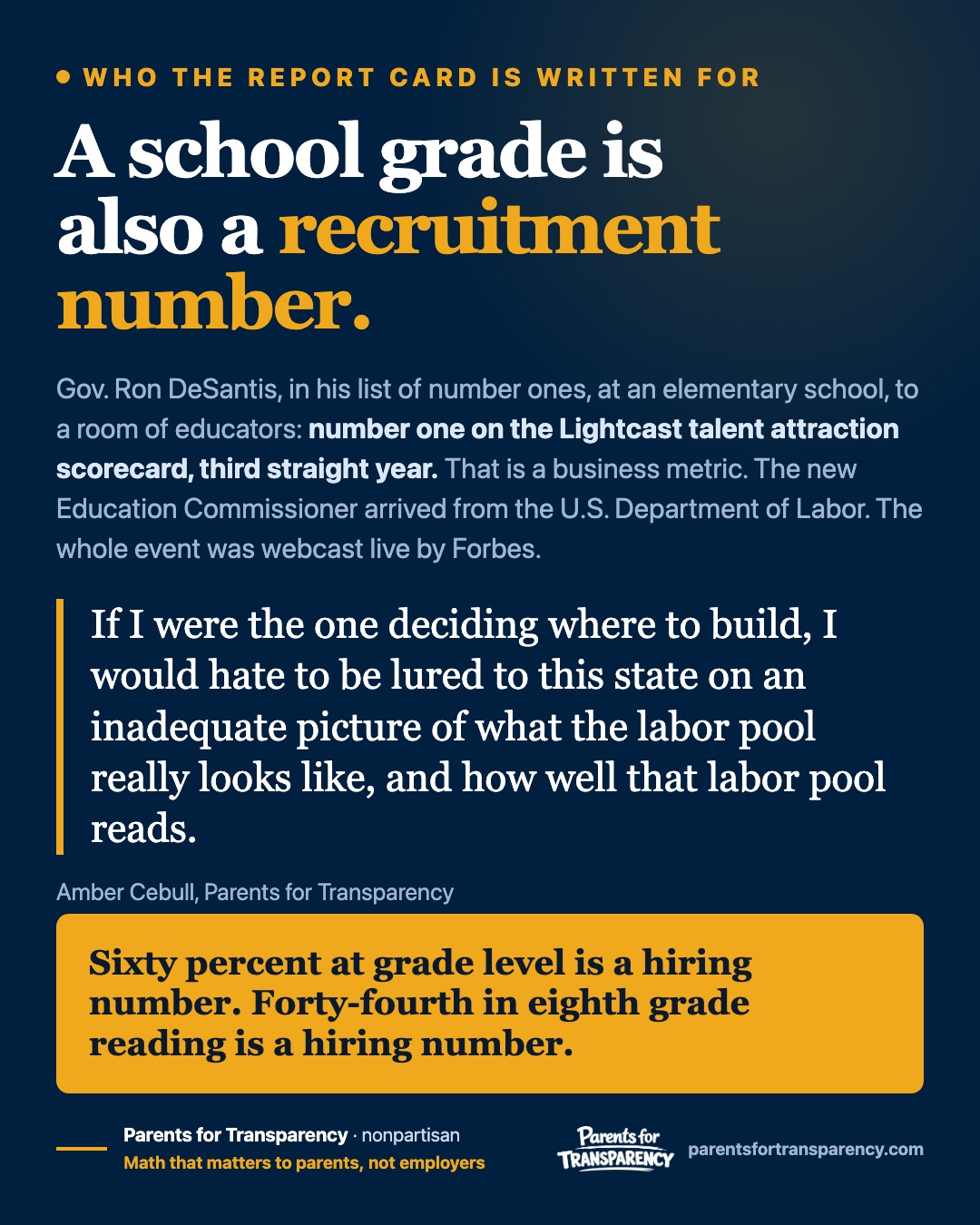
There is one more thing buried in that list of number ones. Between the education rankings, he said this: "We are also number one on Lightcast 2025 talent attraction scorecard and that's the third straight year we've been number one on that metric."
Lightcast is a labor market analytics firm. Its talent attraction scorecard is a business metric, the kind of number a state puts in front of employers deciding where to build. He read it out in the middle of a list about how Florida's children are doing, at an elementary school, to a room of educators, and nobody flinched.
School performance numbers are not only a report to parents in this state. They are a sales figure. They are part of what gets shown to companies weighing a move to Florida, which is a reason to want them high that has nothing to do with whether a fourth grader can read.
That is why Forbes was interested in spending an hour webcasting a DeSantis press conference at a seemingly random Lehigh Acres elementary school.
I think our friends in Alva, Lehigh, Buckingham and Gateway should probably be prepared to keep fighting for that land. Because I believe Forbes and DeSantis and many of our local politicians might have other plans for your rural paradise.
So the rankings are the least interesting numbers he brought, and he said so himself. The two that matter were sitting in the same paragraph and were never put next to each other.
Graduating and reading at grade level are not the same number
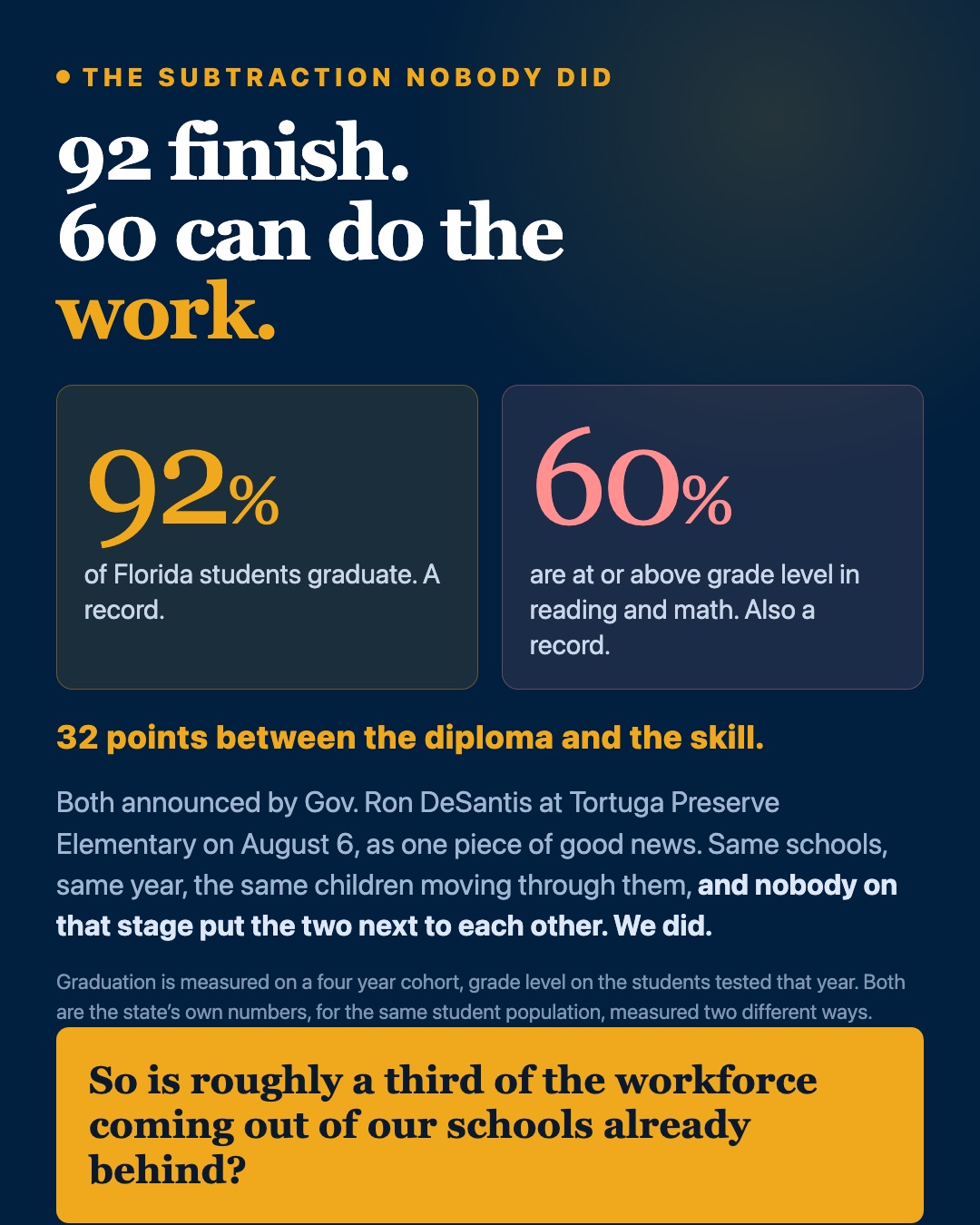
A record 92.2 percent of Florida students graduate. And for the first time ever, more than 60 percent perform at or above grade level in reading and math.
Read that again as a parent instead of as a press release. Ninety-two out of a hundred get a diploma. Sixty out of a hundred can do the work at their grade level. Both figures were announced in the same breath as one piece of good news, and nobody on that stage put them next to each other, so we did. Thirty-two points sit between finishing and being able to do the work. Same schools, same year, the same children moving through them, measured two different ways: graduation on a four year cohort, grade level on the students tested that year. If ninety-two out of a hundred walk out with a diploma and sixty out of a hundred are working at grade level, how much of the workforce coming out of our schools is already behind?
In Lee County the same two numbers, from the state's own school grade calculation, are further apart than that.
- Graduation Rate component: 90 points.
- English Language Arts Achievement: 56 points.
- Mathematics Achievement: 56 points.
Ninety percent graduate. Fifty-six percent read at grade level. A thirty-four point gap between finishing and being able to do it.
Every district in Florida has this gap
I pulled the state's district grade file for all sixty-seven districts and did the subtraction on every one of them. The median Florida district has a thirty-one point gap between its graduation rate and its reading achievement. Lee's thirty-four ranks twenty-first. It is barely above average.
So this is not a story about one district cutting corners. Florida has built a diploma that means something different from proficiency, in every county, and the gap is now so normalized that a governor can celebrate both halves of it in one sentence and no one in the room blinks.
The 92.2 percent is the number that goes on the stage. The 60 percent is the number that shows up when the kid gets to college, or to a job, or to a placement test.
Florida is grading its own test
You might be wondering how state assessment tests factor in.
FAST is Florida's own test. It replaced the FSA in 2022-23, which means the 2023 baseline everyone measures against is the first administration of a brand new assessment. When the state says reading went from 49 to 61, it is Florida grading Florida on a test Florida wrote, against a starting line Florida set three years ago.
There is exactly one external check, the National Assessment of Educational Progress, which every state takes and no state controls. Here is what it said in 2024.
- Fourth grade math: Florida second in the nation, behind only Massachusetts.
- Fourth grade reading: Florida tenth, and yet the score itself fell to its lowest level since 2003.
- Eighth grade reading: 44th in the nation, below the national average, with no significant improvement since 1998.
- Eighth grade math: 41st in the nation, and worse than Florida's own 2003 result.
Florida's fourth graders are among the best in America. The same state's eighth graders are in the bottom ten. Whatever is working in third grade is gone by middle school, and the state test does not show it because the state test says everything is going up.
That is what I mean when I say real numbers from a system that changed what it measures. Nobody faked FAST. Florida just stopped checking its own work against anybody else's ruler.
Ask who this report card was written for
Go back through what got airtime that afternoon and sort it by who would want to hear it.
- Number one in workforce education, hit five years ahead of the 2030 goal.
- Number one on the Lightcast talent attraction scorecard, three years running.
- Number one in public higher education.
- Apprentices out-earning comparable degree holders by $15,000 to $21,000 a year.
- The superintendent noting that most of her students are choosing career and technical education.
Those are labor supply numbers. Workforce pool numbers. Every one of them answers the same question, and the question is not whether your child can read. It is whether a company that moves here will find people to hire.
As someone who does reputation management for a living? I know what damage control looks like when I see it.
The new Education Commissioner introduced himself the same way. Four days into running Florida's schools, he described where he came from: assistant secretary for labor in Washington, "overseeing all employment, training, talent development, and unemployment insurance systems for the nation." The state's top education official arrived from the Department of Labor, and the metrics on the stage were labor metrics.
Forty-fourth in the nation in eighth grade reading. Forty-first in eighth grade math. No significant improvement in eighth grade reading since 1998. Not one of those crossed the podium.
A parent needs the second metrics. A company choosing a state will look at the first.
I keep thinking about the employer on the other end of that pitch. If I were the one deciding where to build, I would hate to be lured to this state under false pretenses, on an inadequate picture of what the labor pool really looks like and how well that labor pool reads. Sixty percent at grade level is a hiring number. Forty-fourth in the nation in eighth grade reading is a hiring number. Neither one crossed the podium.
When Florida has paid a company to come here, the refunds arrive only after the jobs and the wages are verified, and the company owes the money back if it falls short. There is no matching clause on the state side of the table. Nothing anyone signs entitles an employer to an accurate picture of how well the workforce it is recruiting can read, and there is no version of this where the employer gets anything back. The number gets to be a sales figure with none of the obligations that come with selling something.
That is what the grades seem to be for now. Not a report to families about how their children are doing, but a recruitment number, a figure that goes in a pitch deck alongside no state income tax. Which is a reason to want the number high that has nothing at all to do with whether a fourth grader can read, and it explains why a district would rather deny a grading floor than explain one.
Florida already admitted the grades are inflating
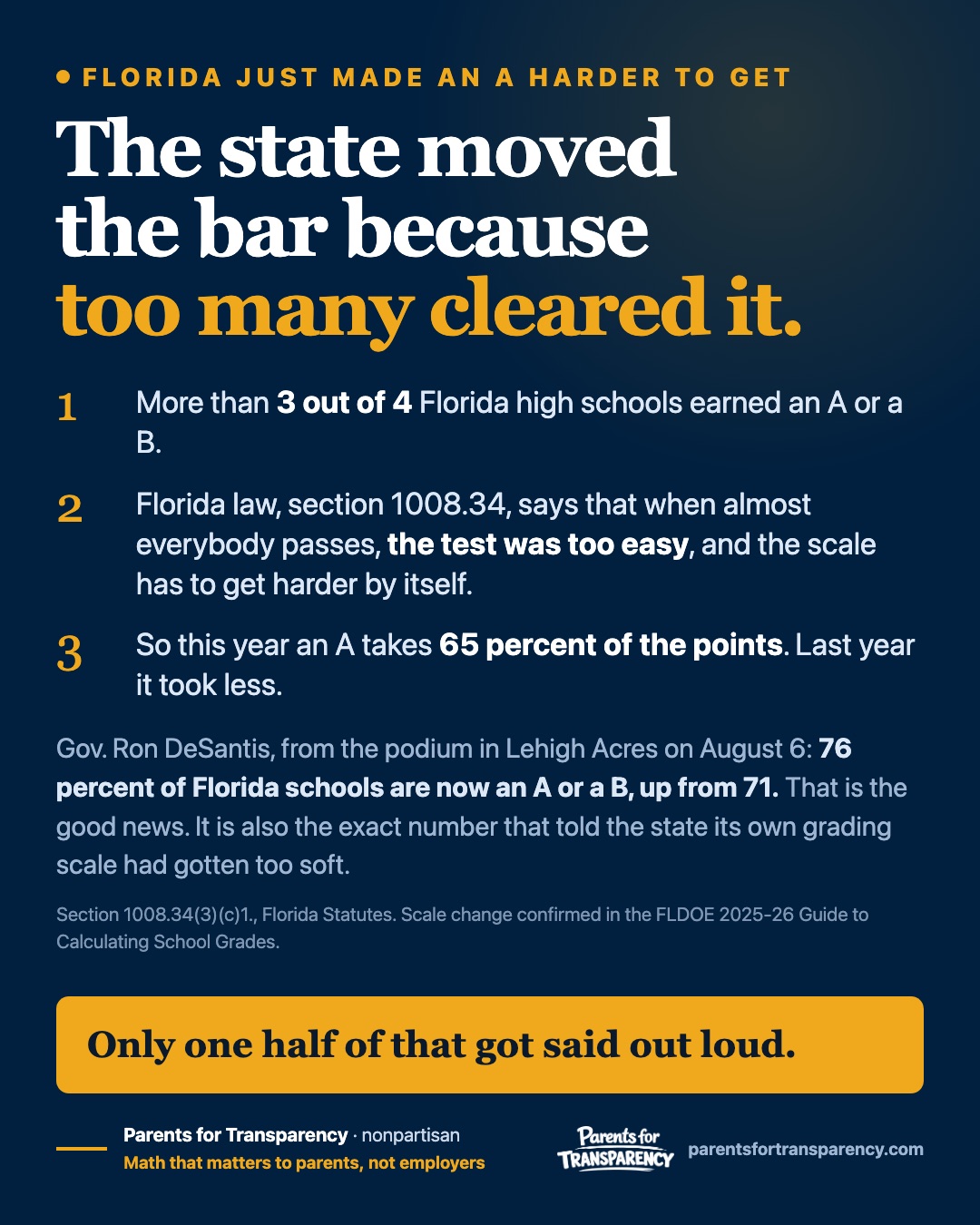
Florida law has a tripwire in it. When more than 3 out of 4 schools of one kind earn an A or a B, the grading scale for that kind gets harder on its own. The Legislature wrote that rule because a bar everybody clears has stopped measuring anything.
This year it went off. An A at a high school now takes 65 percent of the points. Last year it took less.
The number that set it off is the one the Governor read from the podium: 76 percent of Florida schools graded A or B, up from 71. He announced the inflation and its automatic correction in the same breath, as one piece of good news, and left out the second half. Florida's own system looked at those results and decided its scale had gotten too easy.
Where the diploma number can move on its own
A Florida high school's grade is built out of ten components, each worth up to 100 points. Eight of them are test results: reading, math, science, social studies, and learning gains. Two of them are not tests at all.
- Graduation Rate. Did the student earn a standard diploma in four years, which means did they pass their courses.
- College and Career Acceleration. In the state's own words, a C-minus or better in an approved dual enrollment course, or an industry certification.
Twenty percent of a high school's grade rests on course grades and credentials rather than on test scores. That is the surface a grading floor touches. It cannot reach the other eighty percent, and it does not need to.
Which brings us to a district that is telling reporters a 50 percent grading floor is categorically false while its own assessments arrive with the scoring scale printed on them.
The mechanics of that floor: Fifty Percent for Existing: what a lowest grade of 50 does to a student average, and to the two components of a school grade that are not tests
Read next: The floor the district says does not exist, and the documents that say it does
What Lee's 37 points were actually made of
Carlin's 752 is real. It went up 37 points from 715, and it is the best number this district has posted in ten years. I went and got the state's component file to see where those 37 points came from.
- Science achievement: up 10.
- Middle school acceleration: up 8.
- ELA achievement and graduation rate: up 4 each.
- Grade 3 ELA, ELA learning gains, social studies: up 3 each.
- Math achievement and math learning gains: up 2 each.
- College and Career Acceleration: unchanged at 67.
- Math learning gains for the lowest performing 25 percent of students: DOWN 3.
Two of those never get said at a press conference.
The College and Career Acceleration component did not move at all, in the same year this district drove industry certification testing up 56 percent. They ran the push and the component sat still.
And the only component that went backwards is the one that measures whether the weakest math students in Lee County are learning anything. Down three points. Those are the exact children a grading floor is defended as protecting, and they are the only group in the district that lost ground in its best year in a decade.
The comparison nobody made
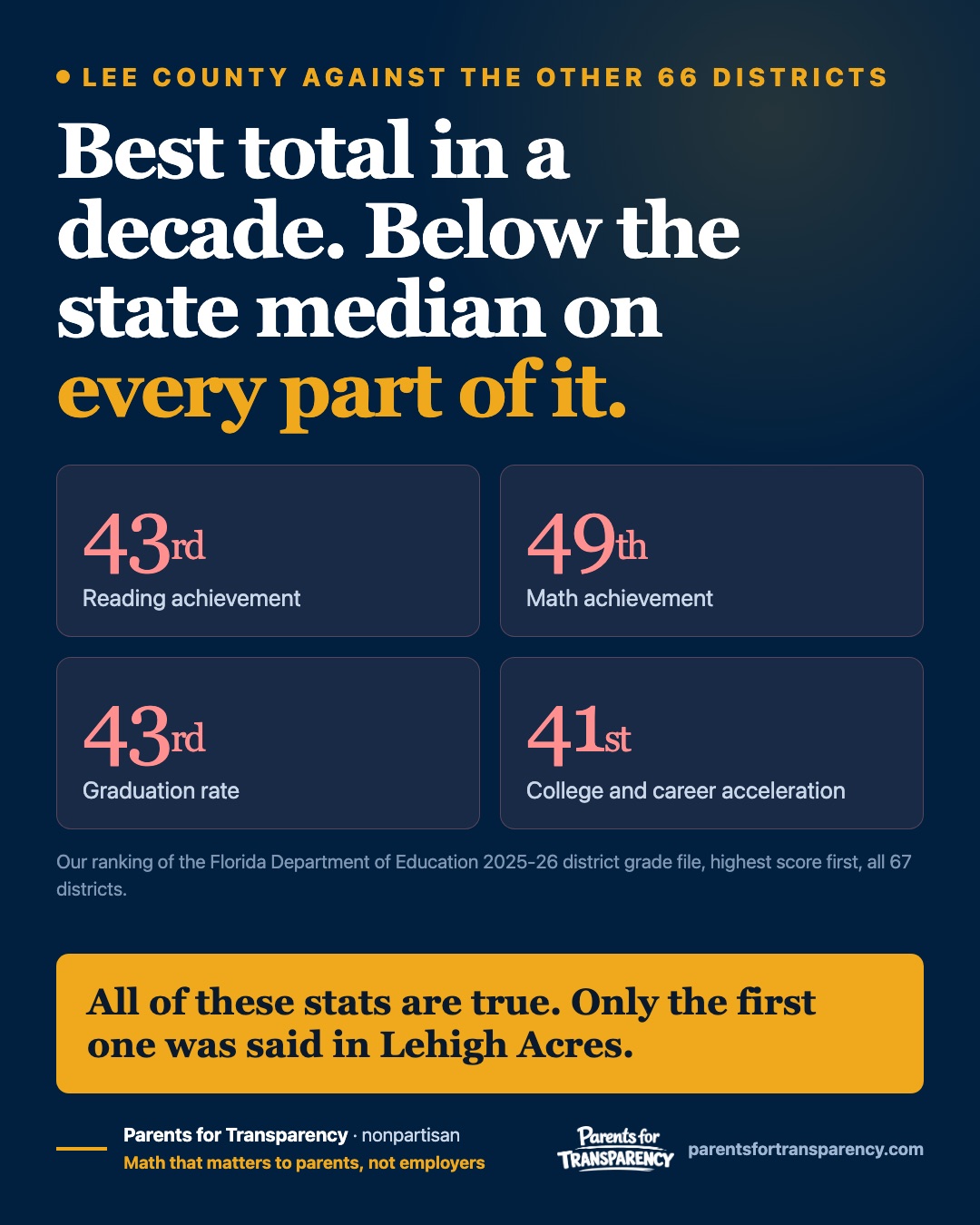
One more number, since we are doing numbers. Against the other sixty-six districts in Florida, Lee County ranks 43rd in reading achievement, 49th in math achievement, 43rd in graduation rate, and 41st in college and career acceleration.
Below the state median on every single component. Highest point total in a decade, and below average on everything that makes up the total. Every one of those is true, and only the first got said in Lehigh Acres.
Two other districts were in the room
In his opening the Governor thanked the school board members who had come: Lee County, and then Hendry and DeSoto. Two neighboring districts sat in the audience of a press conference about how well the host was doing. So I pulled their numbers too.
Hendry County scored 754 district points this year. Lee scored 752.
Hendry is a fraction of Lee's size, considerably poorer, and it finished a hair ahead of the district being congratulated. Now look at how each of them got there. Hendry's graduation rate is 82 percent. Lee's is 89.8. Hendry graduates almost eight percent fewer of its students and still came out with the same score, because it beat Lee on the tests: math achievement 58 to 56, math learning gains 58 to 56, and gains for the lowest performing quarter of math students 57 to Lee's 48.
Two districts, the same total, built out of different parts. One earned its points on what students could demonstrate. The other earned more of its points on how many students finished.
Then there is DeSoto. While Lee gained 37 points and Hendry gained 36, DeSoto County lost 28, falling from 658 to 630. Its graduation rate is 77.8 percent, the lowest in Southwest Florida, and it has moved less than three points in four years. Nobody on that stage mentioned it. If you were a DeSoto parent watching, you would have come away believing your schools were part of a statewide success story.
And then there is the district next door
Collier County is an A. It scored 872 points to Lee's 752, reads at 69 against Lee's 56, does math at 75 against Lee's 56, and graduates 94.4 percent of its students.
Collier's distance between its graduation rate and its reading achievement is 25 points, which ranks 59th out of 67 districts in Florida. Only eight districts in this state have a tighter fit between handing a student a diploma and that student being able to read at grade level. Lee's distance is 34, the twenty-first widest in Florida.
Thirty minutes south on I-75, the diploma means more. That is not a mystery about funding or demographics alone. It is a measurable difference in what the piece of paper certifies.
The number Lee moved fastest
One last comparison, from the state's own graduation file. Over the last four years Florida's graduation rate rose 4.9 points, from 87.3 to 92.2. Over those same four years Lee County's rose 7.3 points, from 82.5 to 89.8, the largest four-year gain of any district in this region. This past year alone Lee moved 4 points while the state moved 2.5.
Lee County is graduating students faster than Florida is. And Lee County ranks 43rd out of 67 districts in reading achievement, 49th in math, and below the state median on every single component of its own school grade.
Those two facts belong on the same page, and on August 6 only one of them made it onto the stage.
There is a version of this event I would have applauded. A superintendent says we went up 37 points, here is where every one of them came from, here is the one that went down and here is what we are doing about it, and here is the gap between our diploma and our reading scores because you deserve to know it. Nobody would have lost anything. The 752 would still be real.
Instead the good numbers went on the stage and the rest of them are sitting in a spreadsheet on the state's website that I had to go download.
They are selectively showing you parts of the picture. And one of those parts tells me they are prioritizing industry and development over our children. But that is just my opinion. I will let you make yours, with this available information they did not share with you.
Early voting is open right now, every day through Saturday, August 15, and Election Day is August 18. You get to decide who is standing on that stage next year. And any of them funded by developers? Probably tells you something.
See for yourself: The 2026 Money Map: every race on your ballot, and who is funding it
Fact check
Every figure attributed to a speaker was said at the August 6 press conference and is quoted from the recording. Every figure attributed to the state comes from FLDOE's own published files, which we downloaded and recomputed rather than taking from a summary. The piece does not allege that any reported number is false. Its argument is that the graduation rate and the proficiency rate measure different things, that Florida's own test has no external referee, and that two of the ten components of a high school grade are decided by course grades rather than test scores. Each of those is documented below.
Checked August 9, 2026
DeSantis said "those numbers don't lie," and separately said rankings should be taken with a grain of salt.
At 27:55 and 1:49 of the full recording. Both are his; he speaks continuously until 28:22, when he hands off to Commissioner Henry Mack and then Superintendent Carlin. We transcribed from the video. METHOD NOTE: the automatic captions on this recording mangle spoken digits, so no numeric claim in this piece is sourced to captions alone. Numbers were verified against FLDOE files.
Florida hit a record 92.2 percent graduation rate and, for the first time, more than 60 percent of students are at or above grade level in ELA and math.
Both announced at the event and both consistent with FLDOE reporting. The piece's point is not that either is wrong. It is that they were presented as two halves of one story when they count different things: one counts diplomas awarded, the other counts students meeting a proficiency standard.
Lee County's graduation rate component is 90 while its ELA and math achievement components are both 56.
2025-26 District Grades file published by FLDOE, Lee County row. These are the state's own component scores, not our arithmetic.
The median Florida district has a 31 point gap between graduation rate and ELA achievement, and Lee's 34 ranks 21st of 67.
Our calculation, and readers should treat it as ours. We took FLDOE's 2025-26 District Grades file, subtracted each district's ELA achievement component from its graduation rate component for all 67 districts, and took the median and Lee's rank. The file is public and the arithmetic is one subtraction per district. We are publishing the method so anyone can repeat it.
The rankings DeSantis cited are based on school choice policy.
Heritage's Education Freedom Report Card and the Center for Education Reform's Parent Power Index both score states substantially on what school choice policy they have enacted. Calling that circular is our characterization. It is fair to note the Governor made a version of the same point himself when he said to take rankings with a grain of salt.
FAST replaced the FSA in 2022-23, so gains are measured against a new test's first administration.
Florida moved to the FAST progress monitoring system for 2022-23. That is why the 2023 baseline the state measures improvement from is the first year of a different assessment. This is a real limit on year-over-year comparison and is not a claim that the scores are manipulated.
NAEP 2024 shows Florida 2nd in 4th grade math, 10th in 4th grade reading, 44th in 8th grade reading and 41st in 8th grade math.
The 2024 National Assessment of Educational Progress. We are reporting the full picture including the results that flatter Florida, because a fact-check that only prints the bad half is not a fact-check. The 4th grade reading score fell to its lowest level since 2003 even while the state ranked 10th, which tells you how far the national baseline has fallen too. Eighth grade reading has not significantly improved since 1998.
A Florida high school grade has ten components, eight of them test-based, and 20 percent rests on course grades and credentials.
2025-26 Guide to Calculating School Grades, District Grades and the Federal Percent of Points Index, FLDOE, pages 5 and 27. A high school is eligible for ELA achievement, ELA learning gains, ELA learning gains lowest 25 percent, math achievement, math learning gains, math learning gains lowest 25 percent, science, social studies, graduation rate and college and career acceleration. Each is worth up to 100 points. The CCA numerator explicitly includes "a C- or better in an approved dual enrollment course" and CAPE industry certifications. Schools serving middle grades can also carry the middle school acceleration component, which is why Lee's district total shows twelve.
Lee's 37 point gain breaks down as reported, and math learning gains for the lowest 25 percent fell 3 points.
Computed by differencing Lee's row in FLDOE's 2024-25 and 2025-26 District Grades files, component by component. Science +10, middle school acceleration +8, ELA achievement +4, graduation rate +4, grade 3 ELA +3, ELA learning gains +3, social studies +3, math achievement +2, math learning gains +2, ELA learning gains lowest 25 percent +1, CCA unchanged, math learning gains lowest 25 percent -3. Total 715 to 752.
Hendry scored 754 district points to Lee's 752 with a graduation rate 7.8 points lower, and beat Lee on the math components.
FLDOE 2025-26 District Grades file. Hendry math achievement 58 vs Lee 56, math learning gains 58 vs 56, math learning gains lowest 25 percent 57 vs 48. Graduation rates from FLDOE's 2024-25 four-year cohort file: Hendry 82.0 percent, Lee 89.8 percent. A caution we are putting in ourselves: 752 and 754 out of 1,200 is effectively a tie, and Hendry is a far smaller district where individual cohorts swing results more. The durable point is the composition, not the two-point margin.
Collier's diploma-to-reading gap of 25 points ranks 59th of 67, and Lee's 34 ranks 21st.
Our calculation from FLDOE's 2025-26 District Grades file, subtracting each district's ELA achievement component from its graduation rate component across all 67 districts. Collier is an A district with 872 points; Lee is a B with 752. We are not claiming the gap is caused by grading practice in either county. We are reporting that the same certificate covers a different distance depending on which side of the county line a student is on.
Lee's graduation rate rose 7.3 points over four years while Florida's rose 4.9.
FLDOE, Florida's High School Cohort Graduation Rate, Table 3, district series 2020-21 through 2024-25. Lee 82.5 to 89.8; Florida 87.3 to 92.2; Collier 91.5 to 94.4; Charlotte 87.9 to 91.6; Hendry 75.7 to 82.0; DeSoto 75.1 to 77.8. A rising graduation rate is a legitimate goal and rising faster than the state is not by itself evidence of anything improper. The piece places it beside Lee's below-median reading and math results rather than treating it as proof on its own.
DeSoto lost 28 district grade points and has the region's lowest graduation rate.
DeSoto fell from 658 to 630 and remained a C. Its 2024-25 graduation rate is 77.8 percent, up from 75.1 four years earlier. DeSoto school board members were thanked by name from the podium as attendees.
Lee ranks 43rd in ELA, 49th in math, 43rd in graduation rate and 41st in CCA out of 67 districts.
Our ranking of the same FLDOE file, highest score first. Ties are ranked by position in the sorted list, so a district sharing Lee's score could be listed a place above or below. The substantive point, that Lee sits below the state median on every component, does not depend on the exact rank.
The grading floor caused the graduation rate to rise.
NOT CLAIMED, and the data cuts against a simple version of it. Most of Lee's 37 point gain came from test-based components the floor cannot touch, with science alone contributing 10. What the piece argues is narrower and survives the data: two components are decided by course grades rather than tests, a floor operates on exactly those, and the district is denying the floor exists while celebrating the total. Anyone citing this piece as proof the graduation rate is fake is misusing it.
The high school grading scale was raised this year.
For 2025-26 an A requires 65 percent of points for high and combination schools, up from the prior scale, triggered automatically under s. 1008.34(3)(c)1., F.S. because more than 75 percent of high schools earned an A or B in 2024-25. Worth knowing in both directions: it means Lee's no-D-or-F result came against a harder bar, and it means the state's own formula registered enough grade inflation to correct itself.
Florida job incentive agreements pay the company only after jobs and wages are verified, and require repayment if it falls short.
The Qualified Target Industry Tax Refund, s. 288.106, F.S., paid refunds over a period of years only after the new high wage jobs and the wages were verified, with recapture if a company missed its targets. The program stopped certifying new applicants after June 30, 2020, and existing agreements continue under their own terms; OPPAGA reviewed the program in Report 22-06. The piece uses the structure of these agreements to make a point about which side of the table carries obligations, not to claim a specific company was recruited with these numbers.
An employer who moved here on the strength of the state education numbers would have a legal claim.
It would not, and the piece does not say otherwise. The figures announced on August 6 are accurate and published; a misleading impression built out of true numbers is not fraud absent a duty to disclose, and no such duty runs from a state to a company reading its recruitment materials. Florida waives sovereign immunity only in the narrow way s. 768.28, F.S. describes, with caps of $100,000 per person and $200,000 per incident, and policy level decisions such as what a state chooses to publicize stay immune. The Lightcast ranking is a private firm's index, not a state representation at all. The argument here is about honesty and about who the report card is written for, not about liability.
Early voting is open now, through Saturday, August 15.
Lee County early voting for the August 18 primary runs Saturday, August 8 through Saturday, August 15, 10 a.m. to 6 p.m., at 12 locations, and a voter may use any of them regardless of their election day precinct. On Election Day, August 18, polls are open 7 a.m. to 7 p.m. and a voter must use their own assigned precinct. Per the Lee County Supervisor of Elections. This sentence needs updating again after August 15.
Fact-check sources
- Full video of the August 6, 2026 press conference, "Supporting Florida's Students," Tortuga Preserve Elementary, Lehigh Acres, as posted by News4JAX (YouTube 5fy6hHe0Kfs, 40 minutes). All quotations carry timestamps; DeSantis speaks until the handoff at 28:22.
- Florida Department of Education, 2025-26 District Grades and 2024-25 District Grades data files.
- Florida Department of Education, Florida's High School Cohort 2024-25 Graduation Rate, Table 3 (district rates, 2020-21 through 2024-25).
- Florida Department of Education, 2025-26 Guide to Calculating School Grades, District Grades and the Federal Percent of Points Index.
- National Assessment of Educational Progress, 2024 state results for Florida.
- WGCU News, Dayna Harpster, August 7, 2026.
About the authors
Amber Cebull Amber is a Fort Myers native. Her two kids, 13 and 12, go to Cypress Lake Middle School. She grew up in Lee County schools herself: Tanglewood Elementary, Allen Park Elementary, Paul Laurence Dunbar Middle School's Gifted Program, Fort Myers High School's IB Program. She graduated from the University of Central Florida with a B.A. in English Literature and a minor in Psychology. An entrepreneur for 15 years, she has owned multiple businesses in the Fort Myers area, including a marketing and business strategy consulting practice and a brewery in Downtown Fort Myers.
Ali Olivo Ali is a Fort Myers mom with two kids, 12 and 9. She has served on the Golden Apple Selection Committee for the Foundation for Lee County Public Schools and on the United Way Allocations Committee. She has more than 18 years of experience in corporate business, M&A, and law. She holds a B.A. from the University of Florida and a J.D. from Marquette University Law School.