
Lee County Says a 50 Percent Grading Floor Does Not Exist. A Staff Memo Says It Comes From the District's Own Handbook.
On Thursday the School District of Lee County told a reporter that claims of a 50 percent minimum grade are "categorically false" and that the district has "no minimums for grading." A memo handed to staff at a Lee County school says the lowest grade that goes in the gradebook is a 50, and says it is following the district's own Secondary Grading Handbook. An assistant principal explained the same floor to teachers on video and attributed it to the chief academic officer. The district's media office then told me something different again: it is not in our handbook, and schools decide for themselves. Then an elementary teacher sent me a district unit assessment with the grading scale printed on it, and the district's own scoring page recommends that a first grader who answers nothing correctly be recorded as a 45. Our fact-check rides at the bottom.
By Amber Cebull and Ali Olivo · August 8, 2026
Let me start with the district's own words, because everything else in this piece is measured against them.
Claims that we have established a minimum grade of 50% are categorically false. We have no minimums for grading.
Rob Spicker, spokesman for the School District of Lee County, to WGCU, August 7, 2026
That is not a clarification or a nuance. That is a flat denial that the thing exists. So let us look at what teachers in this county were handed this month.
The memo
A staff memo from a Lee County school opens by naming exactly which document it is implementing. I am not printing the school. The person who sent it can be identified by it and they cannot afford that.
For the 2026 - 2027 School Year, our school will be following the School District of Lee County's Secondary Grading Handbook. We have taken the impactful and important elements from this handbook and have broken them down below.
Opening lines of a staff memo distributed at a Lee County school for this school year
Then, under a heading that reads Grading Work, the first bullet:
The lowest grade to be put into the gradebook for a general education student for an assessment / assignment is a 50%. If work has not been turned in or completed, this must be documented in the grade notes in Focus.
The same memo, under "Grading Work"
And at the bottom, so nobody mistakes it for a suggestion:
It is a staff expectation and requirement to follow these procedures for each class, daily. Non-compliance will result in a meeting with administration.
Closing line of the same memo
Read those three passages together. A minimum grade of 50. Required daily. Enforced by administration. Presented not as one school's preference but as an element taken from a District handbook that the memo names by title.
The assistant principal said it out loud
WGCU reported on Thursday that in a grading training session on Tuesday, Estero High School's Assistant Principal for Curriculum, Timothy Dougherty, told teachers the 50 percent floor was a policy "coming directly from the top, our chief academic officer." That officer is Nathan Shaker. The reporter had video.
I want to be precise about what that does and does not establish, because precision is the only thing that makes any of this worth reading. I am still not telling you which school the memo came from. What I will tell you is that it is not independent of the training session WGCU reported, and I am not going to let anyone read it that way. Treat the memo and the video as one school, described twice: a written instruction, and a spoken account of where it came from.
So the district's position requires you to believe that an assistant principal misinformed their own faculty about the origin of a grading rule, and that the same school's memo separately invented that same requirement and attributed it by name to a district handbook. Same building, same week, same 50.
Elsewhere in the county it arrives with no paper at all. A teacher at a Lee County middle school told me the same instruction was delivered verbally, in a meeting. That detail matters more than it looks. A rule given out loud leaves nothing to request, nothing to publish, and nothing to hold up afterward. It also leaves the teacher who repeats it standing alone against a district that has already called this account categorically false.
There is a simpler explanation, and every teacher in this county already knows what it is.
So I asked the district myself
On Thursday morning I got an email from Riley Kempton, the district's Assistant Director of Media Relations and Public Information, with the grading handbook attached. I want to give her answer in full, because it is more specific than the public denial and it moves the argument somewhere new.
Attached you will find the grading handbook that was shared from the Academic department to our principals and assistant principals. As you will find in here there is zero mention of a 50% minimum requirement, nor was that ever communicated from the Academic Department. Schools have their own discretion and have had that discretion for many years to set their own grading handbook by a school-by-school basis, of which the faculty of that school has to agree to. Due to that practice, the Academic Department created these grading handbooks to ensure grading practices are equitable and uniform across classrooms, grade levels, and schools.
Riley Kempton, Assistant Director, Media Relations and Public Information, School District of Lee County, by email, August 7, 2026
Read that carefully, because it is not the same claim the district made publicly. Spicker told a reporter there are no minimums for grading. Kempton is telling me something narrower and more interesting: it is not in our handbook, we never told them to, and the schools set their own.
That is a defense that concedes the floor exists. It just relocates it. The 50 is real, the district's account now goes, and it belongs to the buildings.
Notice also that the same paragraph carries both halves of a contradiction. Schools have discretion to write their own grading handbooks, and the Academic Department wrote these handbooks to ensure grading is uniform across schools. Both cannot be the operating principle. Either the district is standardizing grading or it is deferring to each faculty, and the answer determines who is accountable for the number on your child's report card.
I wrote back and asked her plainly whether the district was declining to denounce an inconsistent grading floor across its schools. Her answer:
I believe directly what I told you and what was both in my email and in the handbook is that we are for consistent grading and the purpose of the district handbooks was for that purpose.
Riley Kempton, by email, August 7, 2026
Being for consistent grading is not an answer to whether a grading floor is being applied to children in this county. I asked a yes or no question about a practice and got a statement of values. To her credit, she also offered to set up a meeting with the Chief Academic Officer and the Chief of Schools, and said she was working on a date. I have accepted. I will report what they say.
Then a teacher sent me the test
An elementary school teacher sent me the scoring scale that came with a district unit assessment. They asked me not to use their name, and they described what they were looking at in one sentence. Hold onto their exact words, because they matter more than anything I could write around them.
This is our first unit test for science that is supplied by the district with the grading scale THEY want us to use.
A Lee County elementary school teacher, in writing, August 2026
Here is one of those documents. It is a first grade math unit assessment on two-dimensional and three-dimensional figures, and every scoring instruction on it was written by the district.
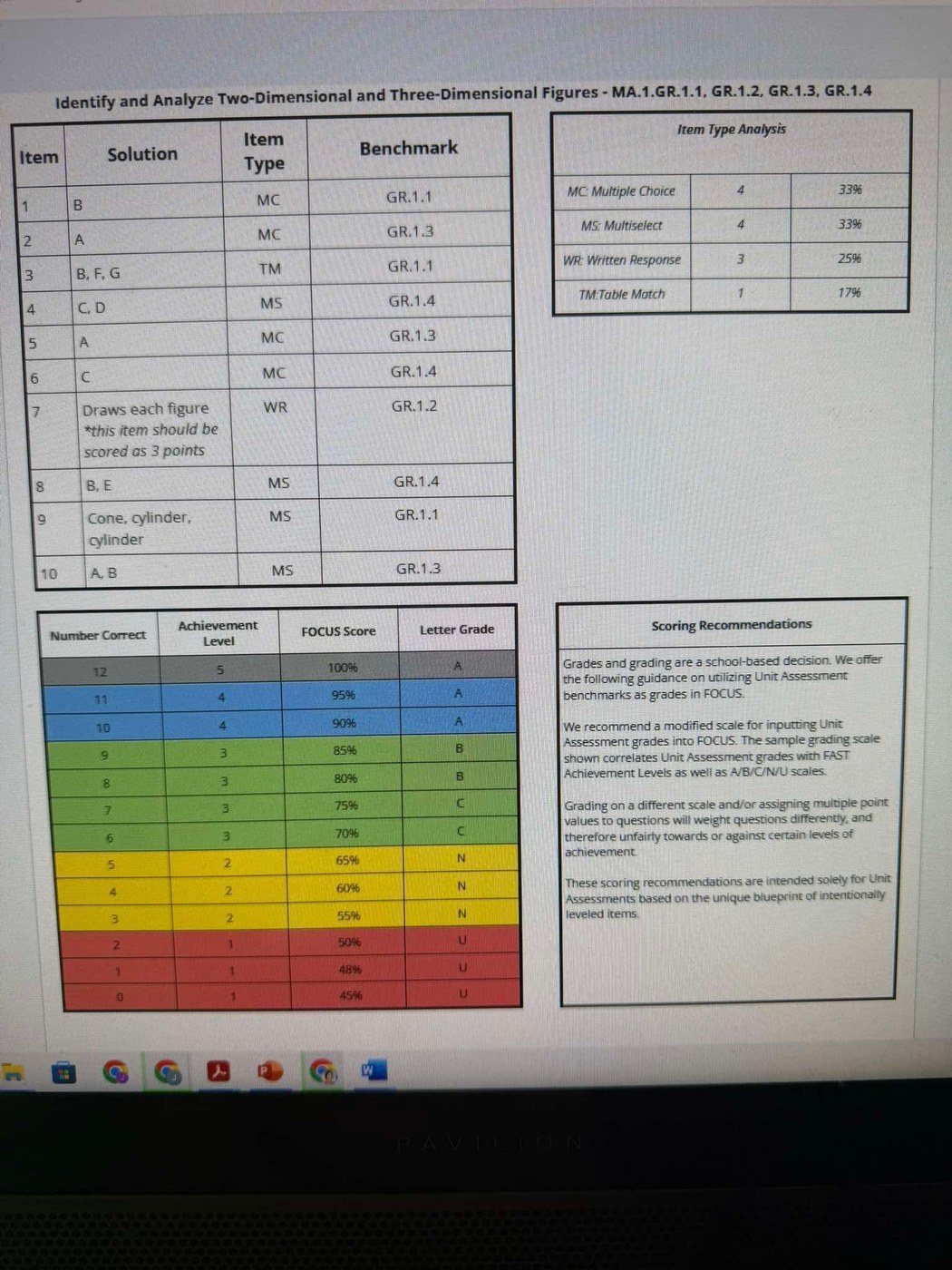
Now read what the district wrote in the box on the right of its own document.
Grades and grading are a school-based decision. We offer the following guidance on utilizing Unit Assessment benchmarks as grades in FOCUS. We recommend a modified scale for inputting Unit Assessment grades into FOCUS. The sample grading scale shown correlates Unit Assessment grades with FAST Achievement Levels as well as A/B/C/N/U scales.
Scoring Recommendations, printed on the district unit assessment
Put those two passages next to each other and there is no gap between them. The teacher says the district supplies the grading scale they want used. The district says it recommends a modified scale and prints the sample it wants used directly on the assessment. Those are the same sentence written by two people with different amounts to lose.
Nobody prints a sample scale on a document they are indifferent about. You publish an example because you want it followed. That is what an example is for.
What the recommended scale actually does
Twelve questions. Here is the conversion the district recommends at the bottom of the range.
- 3 of 12 correct, which is 25 percent of the test, is recorded as 55 percent.
- 2 of 12 correct, which is 17 percent, is recorded as 50 percent.
- 1 of 12 correct is recorded as 48 percent.
- 0 of 12 correct is recorded as 45 percent.
A first grader who answers nothing correctly on a district math assessment is written into the gradebook as a 45. A first grader who gets three of twelve, which is worse than guessing on most of it, is written in as a 55, four points from a passing D.
The district anticipated the objection and answered it on the page, which I will give it credit for. Its stated reason for the modified scale is that doing anything else would be unfair.
Grading on a different scale and/or assigning multiple point values to questions will weight questions differently, and therefore unfairly towards or against certain levels of achievement.
Scoring Recommendations, same document
So the argument is not that the scale inflates. The argument is that the raw percentage is the distorted number and this one is truer. That is a real position and it deserves to be argued in public by the people who hold it, which is the entire point of this piece. What it cannot be is a position the district holds on its own assessments while telling a reporter that claims about minimum grades are categorically false.
The science teacher also sent their scoring table, from a 10 question assessment. On this one, pasted below, zero correct converts to a 50, and three correct converts to a 58 while four correct converts to a 55.
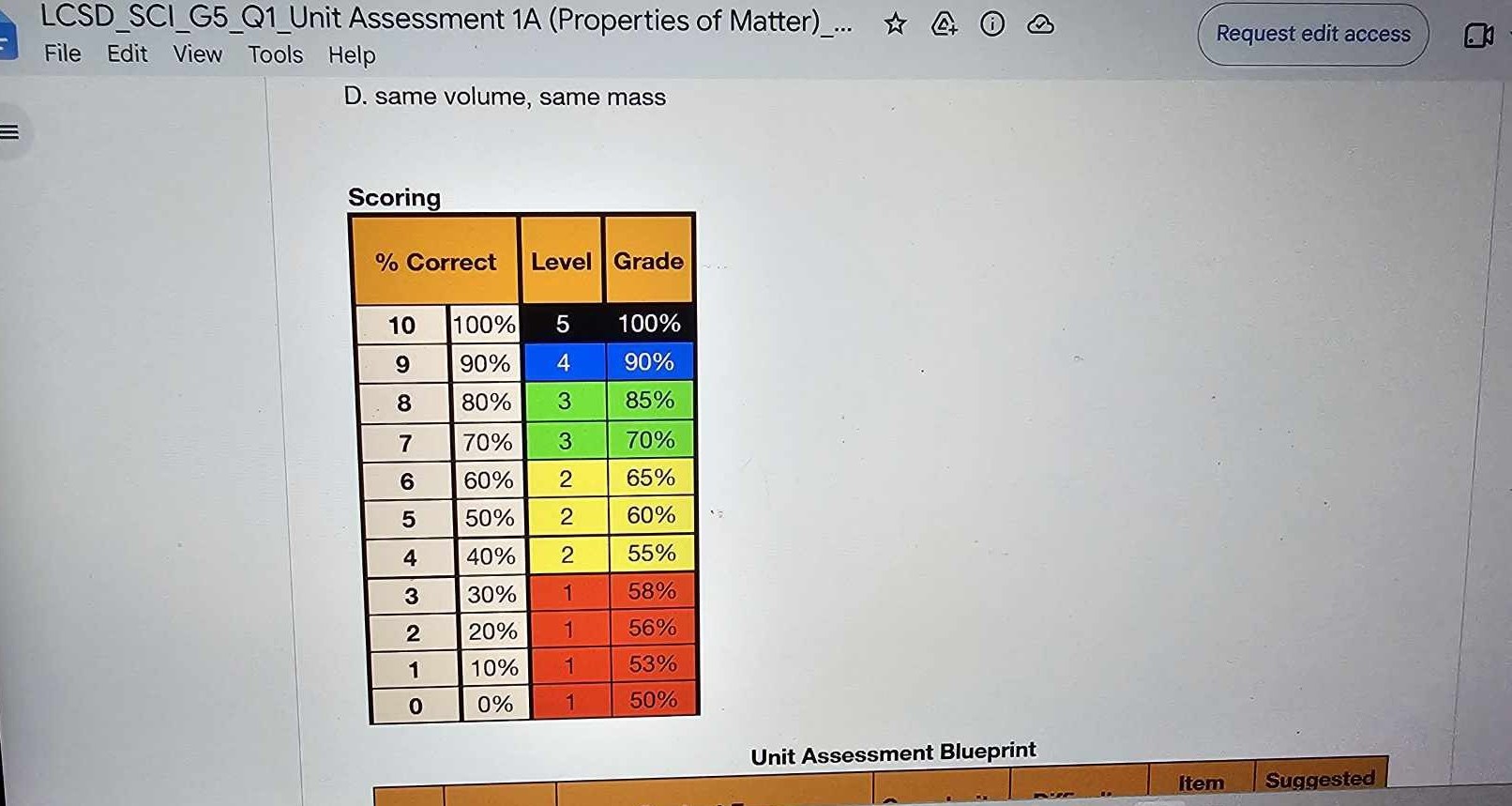
About that school-based decision
The district's media office told me schools have long had discretion to set their own grading handbooks, and this document says the same thing in its first line.
If it is a school's decision to set their own grading standards, why are the tables being printed with grading floors on them? Discretion that arrives with the answer already printed on it is not much of a discretion. The district writes the assessment, decides how many items it has, assigns the achievement levels, builds the conversion table, prints it on the page, calls it a recommendation, and sends it to every teacher who gives that test. Then it says the choice belongs to the school.
A teacher looking at that page does not experience it as an open question. They experience it as the grading scale THEY want us to use, which is exactly the phrase this teacher used before they had any idea what the district would say in its defense.
- A written memo at one high school naming the district handbook and setting the floor at 50.
- That same school's assistant principal telling the faculty it came from the chief academic officer.
- A teacher at a middle school describing the same rule delivered out loud, with nothing on paper.
- District unit assessments arriving with recommended scales that convert a blank test into a 45 or a 50.
- A district spokesman saying the entire thing is categorically false.
Inconsistent standards doesn't serve our children
Look again at the denial. "Claims that we have established a minimum grade of 50% are categorically false." It is possible that sentence is technically survivable, if what it means is that the elected school board never voted on a policy called Minimum Grade. That may well be true. No board member I can find has cast such a vote.
But what is the reality, and what is the polished technically true version of their reality, are different things. A parent hears that their child cannot be given a 50 for handing in nothing. And on the evidence, their child can, and at some schools their child's teacher will be met by administration if they refuse. A statement that is defensible in a lawyer's reading and false in a parent's reading is not transparency. It is the thing transparency exists to prevent.
The district also told WGCU that a grading handbook "was created for this school year to ensure grading practices are consistent across teachers and grade levels." So a handbook exists. The district says so. The memo names it. Nobody outside the buildings has been allowed to read it.
Florida has run this exact play before
In September 2018, an eighth grade history teacher named Diane Tirado was fired from West Gate K-8 School in Port St. Lucie, less than a month into the job, after refusing to give 50 percent to students who turned in nothing. On her way out she wrote on the whiteboard for her kids.
Bye Kids. Mrs. Tirado loves you and wishes you the best in life! I have been fired for refusing to give you a 50% for not handing anything in.
Diane Tirado, on her classroom whiteboard, West Gate K-8 School, Port St. Lucie, September 2018
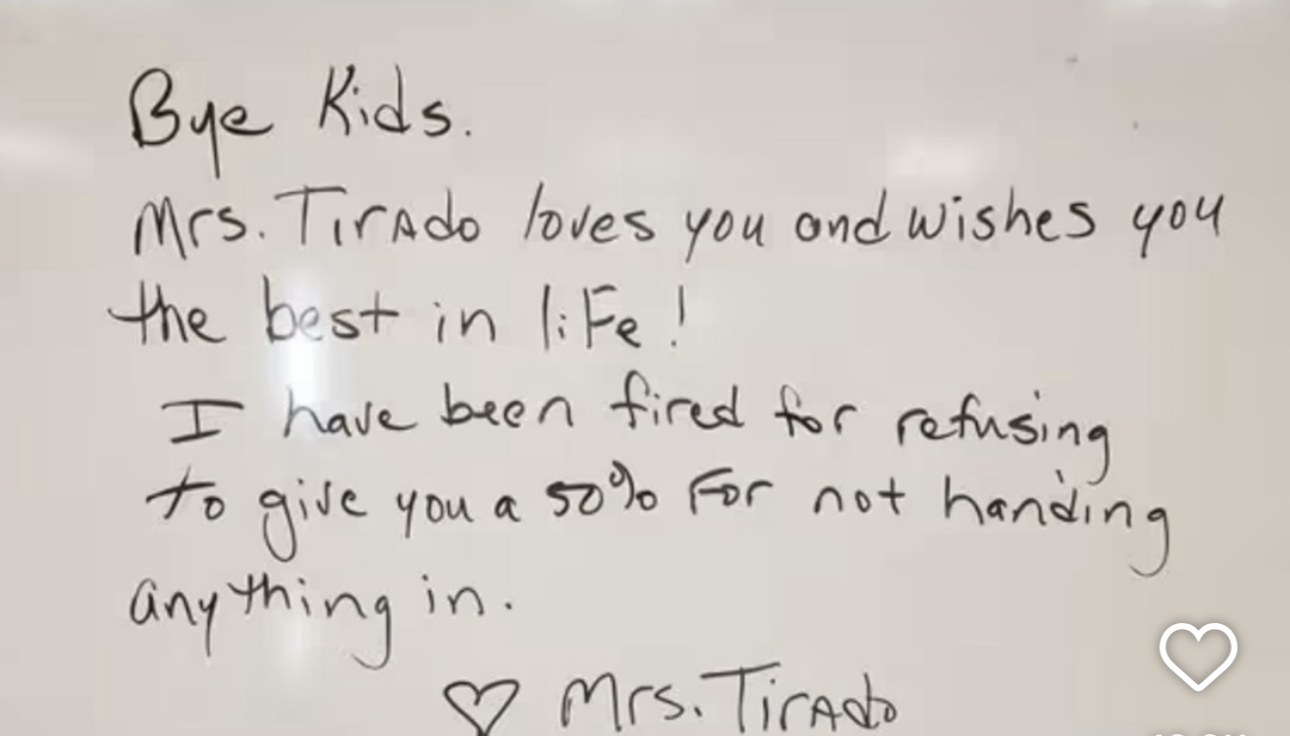
West Gate's own student and parent handbook read: NO ZEROS, LOWEST POSSIBLE GRADE IS 50%. In capital letters. The St. Lucie County district's answer was that "there is no District or individual school policy prohibiting teachers from recording a grade of zero for work not turned in," and that she was released for performance and professionalism.
A school document says the floor. The district says no policy exists. The teacher is the one who ends up unemployed. That was eight years ago and ninety miles up the coast, and the structure is identical to this week.
It also answers the question people keep asking me, which is why teachers do not simply record zeros and let the district explain itself. They have watched what that costs. The Lee memo does not leave it to imagination either. Non-compliance results in a meeting with administration.
Why a floor is worth this much trouble
It is fair to ask why any of this matters if the state tests are the real measure and a grading floor cannot touch them. I went and read how a Florida school grade is actually built, because the answer is in there.
A high school grade is ten components, each worth up to 100 points. Eight are test results. Two are not.
- Graduation Rate. Did the student earn a standard diploma in four years, which comes down to whether they passed their courses.
- College and Career Acceleration. The state's own numerator counts "a C- or better in an approved dual enrollment course" and CAPE industry certifications.
Twenty percent of a high school's grade is decided by course grades and credentials rather than by a test. A grading floor reaches exactly those two components and nothing else, which is the whole point. You do not need to touch FAST to move a school grade. You need to move the number of students who pass their classes.
And in this district the two numbers have come apart. Lee's graduation rate component is 90. Its reading achievement component is 56. Ninety percent finish, fifty-six percent can do the work. The state's own file says so.
Read next: What the Governor and the Superintendent counted in Lehigh Acres, and what they left out
What happens to the same child at the other end
A Lee County middle school teacher wrote to me this week about what the schedule looks like for a student on the wrong side of these numbers. I am not going to quote them and I am not going to tell you what they teach, because there are few enough people doing that job that naming it would name them.
The substance is this. A middle schooler who scores a Level 1 or 2 in reading is put into an intensive reading class. If that student is also a Level 1 or 2 in math, they are put into an intensive math class as well. Two remediation blocks. Then a required social studies sequence lands on top, Law Studies in seventh grade and Civics in eighth. Count the periods in a middle school day and you can see where this goes. Some of these students end up with no electives at all. Not fewer. None.
So think about who that student is. They are the child the 50 exists for. They are the reason the district gives for the floor, the one who would otherwise be buried by zeros. The district's answer to their reading score is to protect their grade, and its answer to their schedule is to take away every class they might have been good at.
The teacher's point, and it is the right one, is that for some kids the elective is the reason they come. It is the one place in the building where they are succeeding at something. Strip it out and you have a student who is failing everything he is scheduled for, passing on paper because of a floor nobody will admit to, and no longer walking into a single room where he is any good.
I know that is true for my kid. His elective classes, chorus and robotics, saved him from leaving the public school system entirely for homeschooling.
The state stopped requiring this in 2015
I assumed this was a state mandate. It is not. Question 32 of the Department of Education's published Secondary Student Progression FAQs asks whether a middle grades or high school student who scores Level 1 or Level 2 on the statewide assessment must enroll the following year in a remedial course, or a content-area course with remediation built into it. The state's own answer:
No. This requirement was deleted as a result of the 2015 Legislative Session. Districts and/or schools continue to make decisions that are in the best interest of each student regarding course enrollment and instructional support. Intensive Reading, Intensive Language Arts, Intensive Writing and Intensive Mathematics continue to be included in the Florida Course Code Directory.
Florida Department of Education, Secondary Student Progression Frequently Asked Questions, question 32
Districts and schools decide. Eleven years ago the Legislature took this exact decision away from Tallahassee and handed it to people who work in the building.
And Lee County's own Student Progression Plan, the public document, is written permissively. Middle grades students experiencing difficulty with mathematics, it says, may be enrolled in an intensive mathematics course. May. Not shall, not must.
That is the same shape as everything else in this piece. The published document says one thing in soft language, the practice inside the buildings is something harder, and the district's public position is that the harder version does not exist. A parent who reads the progression plan would come away thinking their child's schedule was a judgment call made by someone who knows them. The teachers describe a sort.
There is one more turn of the screw, ten questions earlier in the same FAQ. Middle schoolers must take a semester of physical education each year, and one of the listed grounds for waiving it is that the student is enrolled or required to enroll in a remedial course. So the remediation can take the last movement of the day too.
One more page worth looking at
Teachers have written to me this week describing a change in how final grades are calculated, converting letter grades into points rather than averaging percentages. So I went looking for that rule in the handbook. Page 18 is titled Final Grade Calculator, and it says this:
In the context of this Grading Handbook, the Quality Point Calculator would be a resource designed to help teachers or administrators accurately compute the final, or semester, course grade, especially in complex scenarios like those involving End-of-Course (EOC) exams or weighted categories, as referenced in the section.
School District of Lee County, Secondary Grade Reporting Handbook FY27, page 18
Underneath that sit two headings. Final or Semester Grade Calculator Using Quality Points. Quality Points Calculator.
Underneath those, there is nothing. No table, no formula, no worked example, no image. The section is a title, a description of a resource, and empty space.
Notice the tense in the sentence the district wrote: the Quality Point Calculator "would be" a resource designed to help. Would be. That is how you describe something that does not exist yet, in a handbook issued to principals to govern how children are graded this year.
Now hold that next to the district's website. Lee maintains a page on leeschools.net, under Curriculum Standards and Instructional Materials, titled Quality Points for Grade Calculation. I pulled it on Friday. Here is the entire content of that page.
Under Construction! Please check back at a later date for updated information.
leeschools.net, "Quality Points for Grade Calculation," retrieved August 8, 2026
Interesting that that page would no longer be available when we were told directly by many teachers to go research it. Is the district covering its tracks? We will let you make that conclusion on your own.
The handbook section is empty and the webpage explaining it is under construction. Teachers are being told to convert grades using quality points, and the two places the district would explain how are both blank. That is why I have refused to print anybody's worked example of what quality points do to a failing student. I cannot check the arithmetic against a rule, because the district has not written the rule down in either place it promised to.
A parent who goes looking for how their child's final grade is computed finds a heading with nothing under it, and a webpage promising to explain later.
What I want, and it is small
This is one of the easiest things a school district has ever been asked for.
- Publish the grading handbooks on leeschools.net. The district has now emailed them to a reporter and to me, so nothing in them is confidential. Post them where a parent can find them without knowing who to ask.
- Publish the school-level grading handbooks too. If the district's position is that each faculty writes its own, then there are dozens of these documents governing how children are graded, and not one of them is public.
- Explain the scoring scale attached to the district's own elementary science unit test, specifically why zero correct answers converts to a 50 and why three correct answers scores higher than four.
- Publish the quality point rule for converting quarter grades into a final grade, or take the under-construction page down until it is real.
- Tell us whether a Lee County teacher may record a zero for work never turned in, and whether refusing to enter a 50 is grounds for a meeting with administration at any local high schools.
Notice what is not on that list. I have not asked anyone to abandon a grading floor. There are educators I respect who will argue that a 50 is the more honest number, and that argument deserves a real hearing in public, on the record, in front of the people whose children it applies to.
That hearing is impossible while the district's public position is that the thing does not exist.
Why I am not letting this go
Every teacher who described their own staff memo to a reporter this week is now a person whose employer has publicly said their account is categorically false. The elementary teacher who sent me their science scoring scale asked me to keep their name out of it, and they were right to ask. That is the actual climate here. People who work with children are afraid to describe their own job out loud.
The district has been more careful with me than it was with the public. Kempton did not tell me no minimum exists anywhere. She told me it is not in the district handbook and was never communicated by her department, and that schools decide for themselves. That is a real answer and I am treating it as one. It is also an answer that puts a 50 percent floor on a district science test, in a district conversion table, attached to a district assessment, and calls it a school's own idea. But never informed the parents.
If the Chief Academic Officer sits down and shows me that scale is a mistake nobody caught, I will print that. If the school-level handbooks come out and most of them contain no floor, I will print that too, at this length, with my name on it. I hope I have this entirely wrong.
But I refuse to pretend that the school district denial tells the entire story. Because what it looks like from my lens? Is a pack of carefully worded lies.
What I will not do is pretend a denial is the same thing as a document.
Read next: According to DeSantis the numbers do not lie. We went and got the state's own files.
Read next: What a floor of 50 actually does to your child's average
Fact check
Every quotation is verbatim from a source we hold: the district's own words to WGCU, a staff memo distributed at a Lee County school, a live district webpage, and 2018 news coverage of the Tirado firing. The piece's central factual claim, that a school memo attributes a 50 percent grading floor to a District handbook while the district publicly denies any minimum, is documented on both sides. The piece's ARGUMENT, that the denial is misleading rather than false, is opinion and is labeled as such below.
Checked August 8, 2026
A district spokesman said claims of a 50 percent minimum are "categorically false" and that the district has "no minimums for grading."
Rob Spicker, quoted by WGCU on August 7, 2026. Verified against the raw article text, not a summary. He also said a grading handbook was created for this school year for consistency, which the piece quotes as well so his full position is represented.
A staff memo at a Lee County school sets the lowest gradebook entry at 50% and attributes its contents to the district's Secondary Grading Handbook.
Quoted verbatim from the memo. The school name is redacted at our end to protect the person who provided it, which means readers cannot independently verify which building it came from. That is a real limit and we are stating it rather than hiding it. We have not seen the Secondary Grading Handbook itself. The memo names it; that is not the same as reading it, and the piece does not claim otherwise.
An Estero High assistant principal told teachers the floor came from the chief academic officer.
Reported by WGCU, which had video of the training session. Timothy Dougherty, Assistant Principal for Curriculum; the chief academic officer is Nathan Shaker. Neither has been interviewed by us, and neither has responded publicly as of publication.
The district's denial may be technically defensible.
This is the piece's own concession and we think it is the fair reading. If "established" means a formally adopted school board policy, no such policy appears in the board's records, and the denial would then be accurate on its own terms while still misleading a parent. The piece argues that distinction is the problem. That is opinion, not fact.
Diane Tirado was fired in 2018 after refusing to give 50 percent, and West Gate's handbook contained a no-zeros rule.
Confirmed against contemporaneous 2018 coverage, not the social media repost currently recirculating. She was terminated September 14, 2018, weeks into the job, during a probationary period. IMPORTANT AND INCLUDED IN THE PIECE: the St. Lucie district disputed her account, said no policy prohibited zeros, and said she was released for sub-standard performance and unprofessional interactions. We cannot adjudicate that dispute and do not try to. What is verifiable is the handbook language and the shape of the district's response.
Lee County maintains a webpage titled "Quality Points for Grade Calculation" whose entire content is an under-construction notice.
Raw HTML retrieved August 8, 2026 from leeschools.net under Curriculum Standards and Instructional Materials. An unfinished webpage is not by itself evidence of concealment, and the piece does not say it is. Districts leave pages unbuilt for ordinary reasons.
Final grades are being converted using quality points in a way that lets a student fail most of the year and still pass.
NOT REPORTED AS FACT, deliberately. A teacher described this to us in writing this week. We could not make the specific example work: on a scale of A=4 through F=0, three failing quarters and one D average to 0.25, which is an F. There may be a rounding or weighting rule we have not seen, or the example may describe a semester rather than a year. Until the handbook shows the rule, we are not printing the claim. Separately, the quality point VALUES themselves are set out in the district's Student Progression Plan and are not in dispute.
The school board never voted on a minimum grade policy.
We can find no such vote and no such agenda item, and the district has not pointed to one. Absence of a record in the public agenda system is strong but not conclusive; a board policy could be embedded in a broader item under another name. If the district produces the vote, we will correct this.
Middle schoolers scoring Level 1 or 2 are placed in intensive reading and intensive math, plus a required social studies sequence, leaving some with no electives.
This is a Lee County middle school teacher's account of scheduling inside their own building, relayed to us in writing and deliberately paraphrased rather than quoted so the writer cannot be identified. We have not obtained a district scheduling directive and we are not claiming one exists in writing. What is independently verified is the surrounding law: the state requirement was repealed in 2015, Lee's own progression plan uses permissive language, and M/J Law Studies is a real course in the district's middle grades catalog. A parent who wants to test the account can ask their own child's school how many electives a doubly-remediated seventh grader is scheduled for.
Florida repealed the requirement that Level 1 and 2 students take a remedial course.
Florida Department of Education, Secondary Student Progression FAQ, question 18, quoted in full and without trimming: the requirement "was deleted as a result of the 2015 Legislative Session," and districts and schools now decide. Districts may still offer Intensive Reading, Intensive Language Arts, Intensive Writing and Intensive Mathematics. Nothing here says remediation is wrong or that a district choosing it is violating anything. The point is that it is a choice, made locally, and therefore answerable locally.
Lee's Student Progression Plan uses permissive language about intensive math.
Quoted from the plan: middle grades students experiencing difficulty with mathematics "may be enrolled in an intensive mathematics course." We are reading "may" against a teacher's description of an automatic placement. If the district produces a written scheduling rule that makes it mandatory, that document answers the question and we will publish it.
Remedial enrollment can be grounds for waiving middle school physical education.
Same FLDOE Secondary Student Progression FAQs, question 22. One semester of PE per year is required for middle grades students under s. 1003.455, F.S., and the listed waiver options include that the student is enrolled or required to enroll in a remedial course. We are noting what the waiver permits, not asserting how often Lee County uses it.
The district's media office said the 50 percent minimum is not in its handbook and that schools set their own grading handbooks.
Riley Kempton, Assistant Director of Media Relations and Public Information, by email to the author on August 7, 2026, quoted at length and without ellipsis so her full reasoning is on the page. She attached the handbook. She also offered to arrange a meeting with the Chief Academic Officer and the Chief of Schools, which the author accepted and which had not been scheduled as of publication. Her emails carry the standard Florida public records notice.
The district's two public explanations do not match each other.
This is the piece's reading and readers can judge it from the quotations, which are printed in full. Spicker said there are no minimums for grading. Kempton said the minimum is not in the district handbook, was never communicated by the Academic Department, and that schools have long-standing discretion to write their own. Those are compatible if you read the first loosely. They are different claims, and only the second concedes that a floor may be operating in schools.
The same instruction reached at least one other Lee County school.
A teacher at a Lee County middle school told the author the same rule was delivered verbally in a staff meeting, with nothing distributed on paper. We are relaying a teacher's account, not a document, and there is nothing to publish or request because nothing was written down. It is weaker evidence than the memo and is presented as weaker.
The Secondary Grade Reporting Handbook FY27 contains no 50 percent minimum.
We read the full 22-page handbook the district's media office sent. The string "50%" does not appear in it. On that specific point the district's account to us is accurate, and the piece says so plainly. This does not resolve where the schools got the number, which is the open question.
The handbook's quality points section is empty.
Page 18 carries the headings "Final or Semester Grade Calculator Using Quality Points" and "Quality Points Calculator" with no table, formula or example beneath them. We also checked the page's embedded image objects in case the calculator was a graphic; the only images on the page are the document's header banner and footer mark. The descriptive sentence uses the conditional "would be a resource," which we quote exactly. Separately, the grade-to-point values themselves (A=4.0 through F=0.0) DO appear on page 14 of the handbook and are not in dispute.
An elementary science unit test supplied by the district converts zero correct answers to a grade of 50.
From a scoring table photographed by a Lee County teacher who provided it on condition of anonymity and who states it came with a district-supplied unit test. The document is published in the piece; its own title bar reads LCSD_SCI_G5_Q1_Unit Assessment 1A (Properties of Matter), which is district file naming. LIMITS, stated plainly: we did not receive the underlying file, only a photograph of it on a screen, and the district has not confirmed to us that it authored the scale. We asked. This is a teacher's account of a document, plus the document's own contents and its own title, which is stronger than an account alone and weaker than a district acknowledgement.
On the same scale, three correct answers scores higher than four correct answers.
Read directly off the table: 3 of 10 converts to 58, 4 of 10 converts to 55. It appears to be a structural artifact rather than a typo, because each performance level is scaled independently and the top of Level 1 lands above the bottom of Level 2. We are describing what the table does, not asserting anyone intended that result, and the piece says so.
The floor on the science scale proves the district mandates a floor district-wide.
It does not, and the piece does not claim it. One assessment's scoring table is evidence that at least one district-supplied document contains a floor. It undercuts the claim that grading floors are purely a school-level choice; it does not establish a district-wide mandate. That distinction is the difference between reporting and overreaching, and we are staying on the reporting side of it.
Fact-check sources
- WGCU News, Dayna Harpster, "For some students in Lee County public schools is 50 percent the lowest possible grade?", August 7, 2026.
- Staff memo, General Grading Practices, distributed at a Lee County school for the 2026-2027 school year; school name redacted by us to protect the source.
- Email correspondence between the author and Riley Kempton, Assistant Director of Media Relations and Public Information, School District of Lee County, August 7, 2026.
- Scoring conversion table supplied with a district elementary science unit test, provided by a Lee County teacher on condition of anonymity.
- School District of Lee County, Secondary Grade Reporting Handbook FY27 (22 pp., updated 03/10/2026), provided to the author by the district's media office; see p.14 for the grade scale and p.18 for the quality points section.
- School District of Lee County, "Quality Points for Grade Calculation," leeschools.net, retrieved August 8, 2026.
- Contemporaneous 2018 coverage of the Diane Tirado firing at West Gate K-8 School, Port St. Lucie, including the St. Lucie County school district's response.
- School District of Lee County Student Progression Plan.
- Florida Department of Education, Secondary Student Progression Frequently Asked Questions, questions 22 and 32 (PDF).
About the authors
Amber Cebull Amber is a Fort Myers native. Her two kids, 13 and 12, go to Cypress Lake Middle School. She grew up in Lee County schools herself: Tanglewood Elementary, Allen Park Elementary, Paul Laurence Dunbar Middle School's Gifted Program, Fort Myers High School's IB Program. She graduated from the University of Central Florida with a B.A. in English Literature and a minor in Psychology. An entrepreneur for 15 years, she has owned multiple businesses in the Fort Myers area, including a marketing and business strategy consulting practice and a brewery in Downtown Fort Myers.
Ali Olivo Ali is a Fort Myers mom with two kids, 12 and 9. She has served on the Golden Apple Selection Committee for the Foundation for Lee County Public Schools and on the United Way Allocations Committee. She has more than 18 years of experience in corporate business, M&A, and law. She holds a B.A. from the University of Florida and a J.D. from Marquette University Law School.